
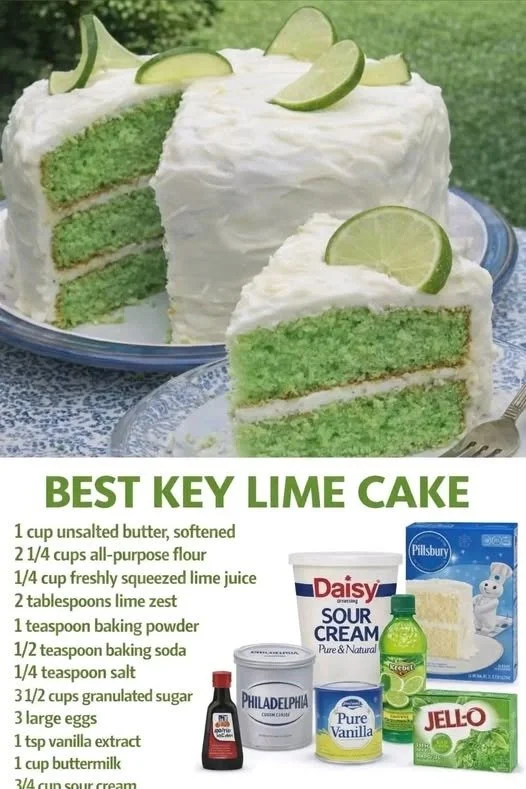
Now, for the cake itself. I preheat my oven to 350°F (175°C) and generously grease and flour my 9×13 pan, or I line my round pans with parchment paper circles for easy release. In my stand mixer, I cream the softened butter and sugar together on medium-high speed for a full 3-5 minutes. It should become very light, fluffy, and almost white. This step aerates the batter, which is key for a tender crumb. I then add the eggs one at a time, letting each fully incorporate before adding the next. I scrape down the bowl often—don’t let any hidden pockets of butter lurk at the bottom.
In a separate bowl, I whisk together my sifted flour, baking soda, baking powder, and salt. In a large measuring cup, I combine the room-temperature buttermilk, fresh lime juice, lime zest, and vanilla. It will look a little curdled and wild, and that’s perfectly fine. With the mixer on low, I add the dry ingredients and the wet ingredients to the butter mixture alternately, starting and ending with the dry ingredients. I usually do three additions of dry and two of wet. I mix only until the last streak of flour disappears. The batter will be thick, creamy, and speckled with beautiful green zest.
I pour the batter into my prepared pan, smoothing the top with a spatula. I give it a gentle tap on the counter to settle any air bubbles. Into the preheated oven it goes, right on the middle rack. For a 9×13 pan, this usually takes 35-40 minutes for me. For round layers, start checking at 25 minutes. The trick is to not overbake. The cake is done when a toothpick inserted into the center comes out with a few moist crumbs clinging to it, not completely clean. Overbaking is the enemy of moisture. I let it cool completely in the pan on a rack before even thinking about frosting.
Pro Tips for Best Results
The single most important tip I can give you is to use fresh lime juice and zest. I tested this three different ways: with all fresh juice, with a mix, and with all bottled juice. The bottled juice cake was flat, one-dimensional, and vaguely metallic. The fresh juice cake was vibrant and complex. Don’t skip this ingredient; it makes a huge difference. If you can’t find key limes, regular Persian limes work beautifully—just know the flavor profile is a bit different.
Room temperature ingredients are not a suggestion; they are the law for this cake. Here’s what I learned the hard way: adding cold buttermilk to creamed butter can cause the emulsion to break, making your batter look grainy and separated. This can lead to a dense, greasy texture. To quickly bring eggs to room temp, I place them in a bowl of warm (not hot) water for 10 minutes. For buttermilk, I microwave it in 10-second bursts until it’s no longer cold.
For the frosting, ensure your cream cheese and butter are truly softened. If they’re too cold, you’ll have lumps. If they’re too warm, your frosting will be soupy. The perfect consistency is spreadable but still holds a peak. I always sift my powdered sugar to avoid any lumps, and I add the lime juice last, a tablespoon at a time, to control the consistency. A slightly tangy, not-too-sweet frosting is the perfect complement to the cake.(See the next page below to continue…)