
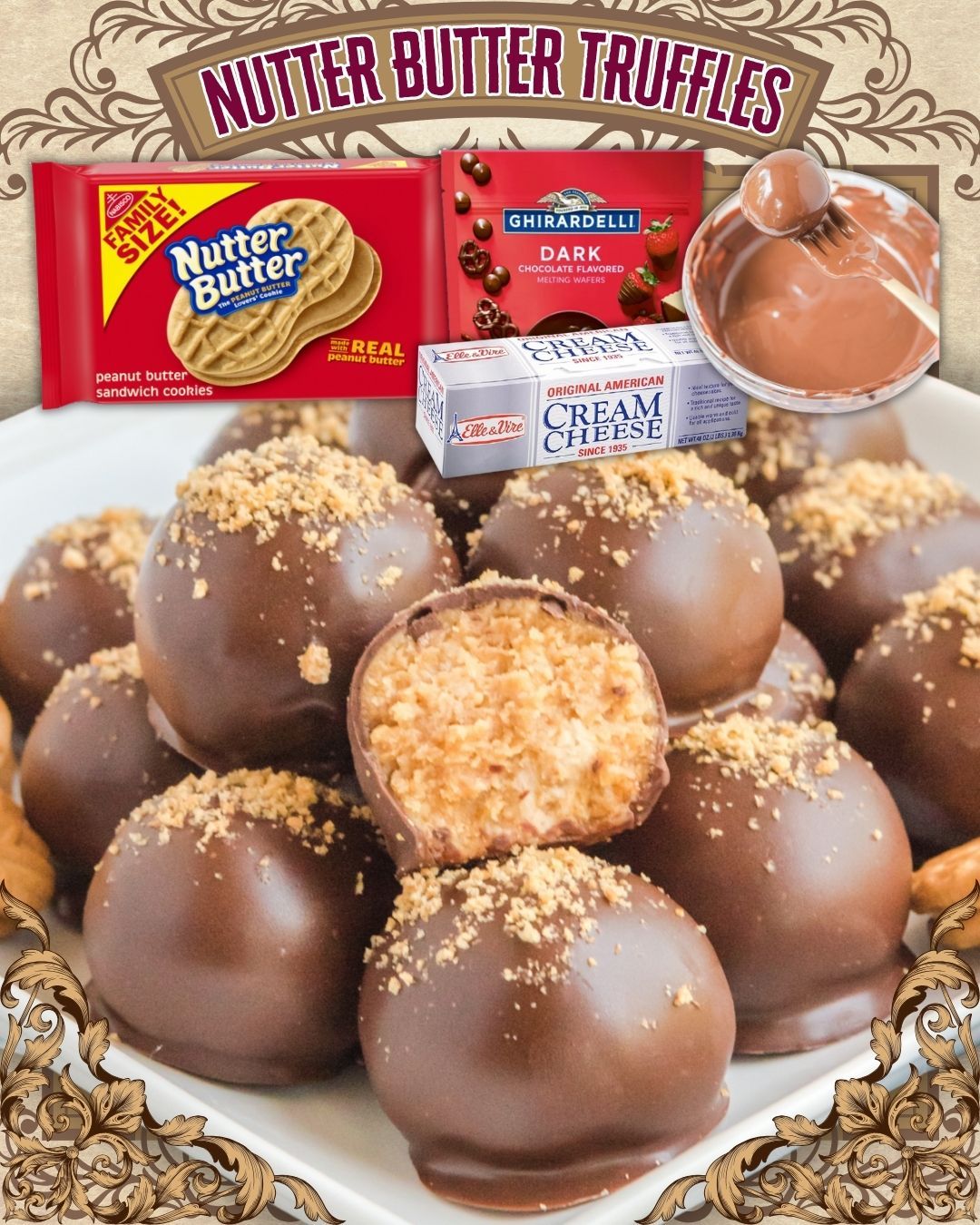
These truffles use Nutter Butter cookies themselves as the base, so you do not have to make peanut butter filling from scratch. The cookies are crushed into fine crumbs, then blended with softened cream cheese, a bit of powdered sugar, and sometimes extra peanut butter until the mixture forms a thick, “dough‑like” filling.
That dough is scooped and rolled into balls, chilled until very firm, and then each ball is dipped in melted chocolate or chocolate melting wafers and topped with cookie crumbs, chopped nuts, or sprinkles before the coating sets. The result is a tray of glossy chocolate truffles that look bakery‑ready but come together with just a handful of ingredients and no baking at all.
Equipment
- Food processor or blender to crush Nutter Butter cookies into fine crumbs.
- Mixing bowl for combining crumbs, cream cheese, sugar, and peanut butter.
- Hand mixer or spatula to blend the truffle filling until smooth.
- Baking sheet lined with parchment or wax paper for setting truffle balls.
- Small cookie scoop or tablespoon to portion even truffle balls.
- Microwave‑safe bowl or double boiler for melting chocolate or wafers.
- Forks or dipping tools for coating truffles in melted chocolate.
- Airtight container for storing finished truffles in the refrigerator or freezer.
Ingredients
- 16 oz (about 450 g) Nutter Butter cookies, crushed into fine crumbs.
- 8 oz (225 g) cream cheese, softened to room temperature.
- ¼ cup (30 g) powdered sugar.
- ¼ cup (60 g) creamy peanut butter (optional but adds extra peanut flavor).
- 10–16 oz (280–450 g) chocolate melting wafers or chocolate chips (milk, semisweet, or dark) for coating.
- 1 tablespoon (14 g) shortening or coconut oil, optional, to thin melted chocolate for smoother dipping.
- 1–2 tablespoons reserved Nutter Butter crumbs, sprinkles, chopped peanuts, or flaky sea salt for topping.
Instructions and steps
To start the truffle filling, the Nutter Butter cookies are crushed into fine crumbs so they mix smoothly with the cream cheese. The cookies go into a food processor and are pulsed until they resemble sand, with no big chunks; a tablespoon or two of crumbs can be set aside at this point to sprinkle on top of the finished truffles. If a food processor is not available, the cookies can be sealed in a zip‑top bag and crushed with a rolling pin, but very fine crumbs help the filling hold together better.
Next, the truffle base is mixed. The cookie crumbs are transferred to a mixing bowl, and softened cream cheese, powdered sugar, and the creamy peanut butter (if using) are added. A hand mixer or spatula is used to blend everything together until the mixture is uniform, thick, and smooth; it should pull away from the sides of the bowl and hold its shape when scooped, similar to a soft cookie dough.
If the mixture feels too sticky to roll, chilling it for about 30 minutes will firm it up; if it seems crumbly, a little extra peanut butter or a splash of cream can help it come together.
The dough is then portioned and rolled into truffle balls. Using a small cookie scoop or tablespoon, portions of about one tablespoon are scooped and rolled between the palms into smooth balls.
The balls are placed on a parchment‑lined baking sheet, with a bit of space between them, until all the mixture is used. This sheet goes into the freezer for at least 20–30 minutes, or into the refrigerator for about an hour, so the centers become firm enough to hold up to dipping without falling apart in the warm chocolate.
While the truffle centers chill, the chocolate coating is prepared. Chocolate melting wafers or chocolate chips are added to a microwave‑safe bowl, along with a spoonful of shortening or coconut oil if desired, and heated in short 20–30 second bursts, stirring between each, until smooth and fully melted. Alternatively, the chocolate can be melted gently over a double boiler on the stove. The goal is a glossy, fluid chocolate that coats the back of a spoon easily but is not so hot that it melts the truffle centers.
To dip the truffles, only a few chilled balls are removed from the fridge or freezer at a time so they stay firm while working. One truffle is placed on a fork or dipping tool and lowered into the melted chocolate, then rolled or spooned over until completely coated.
The fork is lifted, and the excess chocolate is allowed to drip off or is gently tapped on the bowl’s edge. The coated truffle is then slid back onto the parchment‑lined baking sheet, using a second fork or toothpick to help release it if needed. This process is repeated with all of the truffle centers, reheating and stirring the chocolate as necessary to keep it smooth.
Before the chocolate sets, toppings are added. After every few truffles, a pinch of reserved Nutter Butter crumbs, sprinkles, chopped peanuts, or flaky sea salt is sprinkled on top so it adheres to the still‑wet coating.
This not only adds texture and flavor but also gives a visual cue of what is inside and makes the truffles look more finished and festive. Once all the truffles are dipped and topped, the tray is left at room temperature until the chocolate hardens, or placed in the refrigerator for about 10–15 minutes to speed up the setting.
When the chocolate shell is firm, the Nutter Butter chocolate truffles are ready to store and serve. They are best kept in an airtight container in the refrigerator, where they typically stay fresh for up to about two weeks, and can also be frozen for longer storage if needed.
Served chilled or after a few minutes at room temperature, they offer a creamy, peanut‑butter‑forward bite under a crisp chocolate shell that makes them ideal for holiday trays, parties, or edible gifts.
Variations
Once the basic Nutter Butter chocolate truffle formula is in place, it is easy to riff on it. Some recipes emphasize the chocolate coating by using white chocolate instead of milk or dark and then drizzling the set truffles with melted peanut butter or a contrasting chocolate.
Others stir chopped Butterfinger candy bars into the Nutter Butter and cream cheese mixture, creating Butterfinger Nutter Butter truffles that have extra toffee‑like crunch inside and are dipped in chocolate for a candy‑bar‑inspired bite.
A few versions skip the cream cheese entirely and use only peanut butter to bind the crushed cookies, making a firmer, slightly less tangy truffle center that is still dipped in chocolate and topped with sprinkles.
Decoration can also change the character of these truffles. Colorful sprinkles or colored drizzle make them match specific holidays, while chopped peanuts or a pinch of sea salt push them toward a more grown‑up sweet‑salty profile. Using different chocolates—dark for a richer, less sweet finish, or a mix of white and dark for a marbled effect—adds variety to a single batch.
However they are customized, Nutter Butter Chocolate Truffles keep the same core appeal: a crushed peanut butter cookie center, blended with cream cheese, rolled, chilled, and dipped in chocolate to create ultra‑creamy, peanut‑butter‑and‑chocolate truffles that feel special but are secretly very simple to make.