
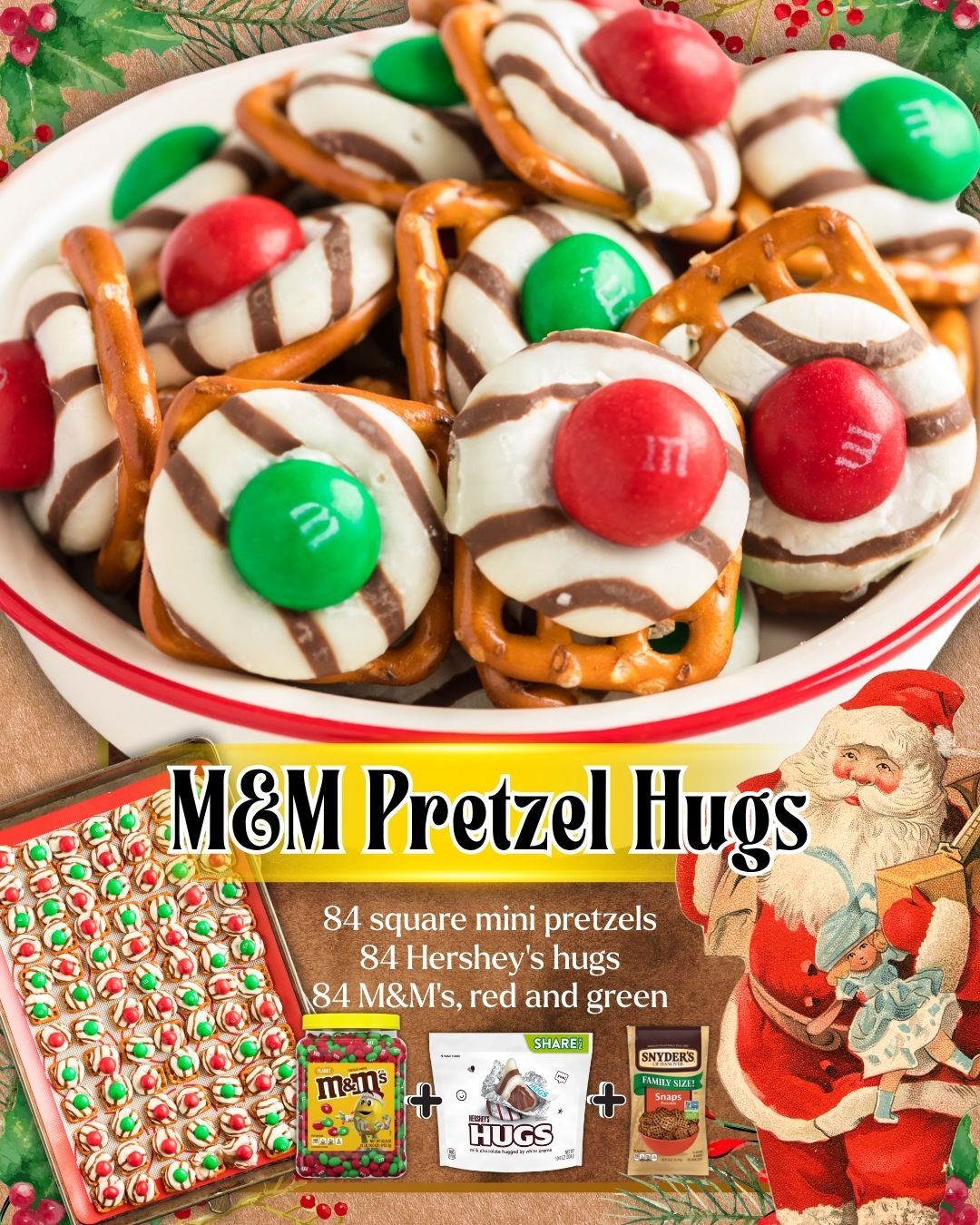
M&M Pretzel Hugs, often called pretzel hugs or Christmas pretzel hugs, are built on a simple layering trick: a pretzel acts as the salty, crunchy base; a Hershey’s Hug provides a swirl of white and milk chocolate that melts just enough to glue everything together; and an M&M pressed into the softened Hug adds color, crunch, and extra chocolate.
The candies are assembled on a baking sheet, warmed briefly in a low oven until the Hugs turn shiny and soft but don’t lose their shape, then topped with M&Ms and cooled until firm. With only a few minutes of active work and almost no prep, you can turn a handful of pantry ingredients into a big batch of colorful, highly snackable treats that are easy to customize for any holiday just by changing M&M colors or Kiss flavors.
Equipment
- Baking sheet large enough for 50–75 pretzels in a single layer.
- Parchment paper or silicone baking mat to line the tray and prevent sticking.
- Oven set to a low temperature, most commonly around 200°F (93°C), though some recipes use 250–320°F with shorter bake times.
- Small bowl or tray to hold unwrapped Hershey’s Hugs or Kisses during assembly.
- Plate or bowl for M&Ms, kept nearby for quick topping as soon as the Hugs come out of the oven.
- Refrigerator or freezer space with a flat shelf to quickly cool the pretzel hugs until the chocolate is set.
- Airtight containers or tins for storing the finished candies at room temperature or in the fridge.
Ingredients
- 84 mini pretzels (square “snap” or waffle pretzels are common, but mini twists also work).
- 84 Hershey’s Hugs (striped white‑and‑milk‑chocolate Kisses), unwrapped.
- 84 M&Ms, ideally red and green for Christmas, or any color mix you like.
One standard bag of Hugs and one regular bag of M&Ms generally give enough candies to cover a full tray of pretzel hugs, so the recipe scales easily: just match the number of pretzels, Hugs, and M&Ms.
Instructions and steps
The process for making M&M Pretzel Hugs is mostly about gentle heat and quick assembly. Everything starts with preheating the oven to a low temperature. Many recipes recommend 200°F (93°C) as the sweet spot, because it is warm enough to soften chocolate without causing it to bloom or fully melt into a puddle.
Some sources go a little higher, up to 250°F or 320°F, but then shorten the time in the oven to just a few minutes so the chocolate doesn’t overheat; these higher‑temp variations often come with stronger cautions to watch closely and test often.
While the oven warms, the baking sheet is lined with parchment paper or a silicone baking mat. This lining keeps the pretzels from sticking, catches any chocolate that might drip or spread, and makes it easy to slide the candies off once they have set.
A single layer of mini pretzels is arranged across the sheet. Square or waffle pretzels (often labeled “snaps”) are particularly popular because their flat tops and grid pattern hold the Hug nicely in place, but mini twists work as well if that is what you have.
Next comes the chocolate layer. Each pretzel on the tray gets one unwrapped Hershey’s Hug placed in the center, point side up. Many recipes note that unwrapping all the Hugs ahead of time and placing them in a bowl beside the tray speeds things up, especially if you are making a big batch or working with kids.
The striped Hugs are traditional because they combine milk and white chocolate and look particularly pretty when they soften, but regular Kisses can be used too.
The tray of pretzel‑and‑Hug stacks goes into the preheated oven. At 200°F, most sources say to bake for about 4–6 minutes—just until the Hugs look glossy and slightly melty but still hold their basic shape and haven’t slumped into flat pools.
At higher oven temperatures, the time can be as short as 2–4 minutes, and recipes almost always emphasize watching carefully and not walking away. A practical visual cue is that the stripes on the Hugs will look soft and the tip will be easily nudged when touched with a toothpick or the edge of an M&M.
As soon as the tray comes out of the oven, the topping step happens quickly while the chocolate is still soft. M&Ms are pressed gently into the center of each warm Hug, pushing down until the chocolate spreads toward the edges of the pretzel.
The goal is to seat the M&M firmly enough that the chocolate hugs both it and the pretzel underneath, but not so hard that the Hug fully spills over the pretzel or the M&M sinks all the way through. If the chocolate seems resistant, the tray may need another 20–30 seconds in the oven; if it squishes too easily, working gently and quickly is key.
Most holiday recipes alternate red and green M&Ms in random patterns or neat rows for a festive Christmas look, but any color can be used; some people even sort M&Ms and use school or team colors for game‑day snacks.
Peanut M&Ms or peanut butter M&Ms can be swapped in for larger, extra‑crunchy candies, though they need a slightly softer Hug so they can be pressed in without cracking everything.
After the M&Ms are in place, the pretzel hugs need to cool and the chocolate must re‑set. One option is to leave the baking sheet at room temperature until the candy is fully firm, which may take 30–60 minutes depending on kitchen temperature.
For faster results, many sources recommend sliding the tray into the refrigerator or freezer for a brief chill—around 5–10 minutes is usually enough for the chocolate to harden and anchor the M&Ms in place. Once the chocolate is completely set and no longer feels tacky, the pretzel hugs can be lifted off the parchment and transferred to storage containers.
For storage, M&M Pretzel Hugs are very forgiving. They can be kept at room temperature in a cool, dry place for several days, especially in winter, or stored in the refrigerator if your kitchen runs warm; in either case, an airtight tin or container keeps the pretzels crunchy and prevents the chocolate from absorbing odors. They are sturdy enough to stack in cookie tins, pack in treat bags, or pile into bowls for parties, and they travel well for cookie swaps, classroom treats, and neighbor gifts.
Variations
Because M&M Pretzel Hugs use only three components and very little technique, they are easy to customize just by swapping which pretzels, chocolates, and toppings you use. One of the most common variations involves changing the Hershey’s Hugs to different Kiss flavors.
Using regular milk chocolate Kisses gives a more uniform chocolate look and a stronger pure chocolate flavor, while dark chocolate Kisses create a richer, slightly less sweet bite that some adults prefer.
Seasonal Kisses, like candy cane, hot cocoa, sugar cookie, or cookies‑and‑cream, bring their own flavors and colors: candy cane Kisses add peppermint bits and pair well with white, red, or even silver decorations, while sugar cookie Kisses turn the hugs more vanilla‑cookie flavored.
The topping candy can also be varied beyond plain M&Ms. Some bakers press peanut M&Ms or peanut butter M&Ms into the softened Hugs for an extra nutty crunch, effectively blending the pretzel hug idea with the peanut‑chocolate profile of other candies.
Reese’s Pieces are another popular alternative, especially around Halloween, adding strong peanut butter flavor and orange‑yellow‑brown colors. For a more turtle‑like twist, pressing a toasted pecan half into each softened Hug instead of an M&M creates a salty‑sweet nut cluster, particularly when caramel‑filled Rolos or caramel Kisses are used in place of Hugs.
Color theming is where these treats really shine for different occasions. At Christmas, red and green M&Ms are classic, but for Valentine’s Day, pink, red, and white M&Ms on top of Hugs or white‑chocolate Kisses make easy heart‑day candies without changing the method.
Pastel M&Ms work for Easter, while red, white, and blue candies turn pretzel hugs into quick Fourth of July snacks. School colors or team colors make them fit game‑day spreads and graduation parties. Because the recipe is so fast, many people make multiple small batches with different color schemes from one bag of ingredients.
Beyond candies, sprinkles can be added to change texture and look. A light shower of nonpareils or jimmies on top of the soft chocolate, sometimes in addition to or instead of M&Ms, gives extra color and crunch.
This approach is especially common when using plain Kisses instead of Hugs or when making very small pretzel hugs for kids’ parties where tiny bites and lots of color matter more than having a big candy on top.
Some variations play with the base pretzel itself. While square snaps are easiest, mini twists, rings, or even butter snaps can be used to subtly alter flavor and appearance. A few recipes mention using gluten‑free pretzels with the same Hugs‑and‑M&M method for a version suitable for gluten‑free diets, as long as all candy labels are checked.
There are also closely related ideas that swap the Hugs for Rolos or chocolate‑caramel candies, creating “Rolo pretzel turtles” where the softened caramel is topped with a pecan or M&M instead of the striped chocolate.
Despite all these options, the core structure never really changes. You still line up pretzels, top each with a Hug or Kiss, warm briefly until the chocolate softens, press on a candy or nut, and cool until firm.
That repeatable pattern is what makes M&M Pretzel Hugs so appealing: they are almost foolproof, endlessly adaptable, and deliver the ultra‑craveable combination of salty crunch, creamy chocolate, and candy‑shell snap in every small, colorful bite.