
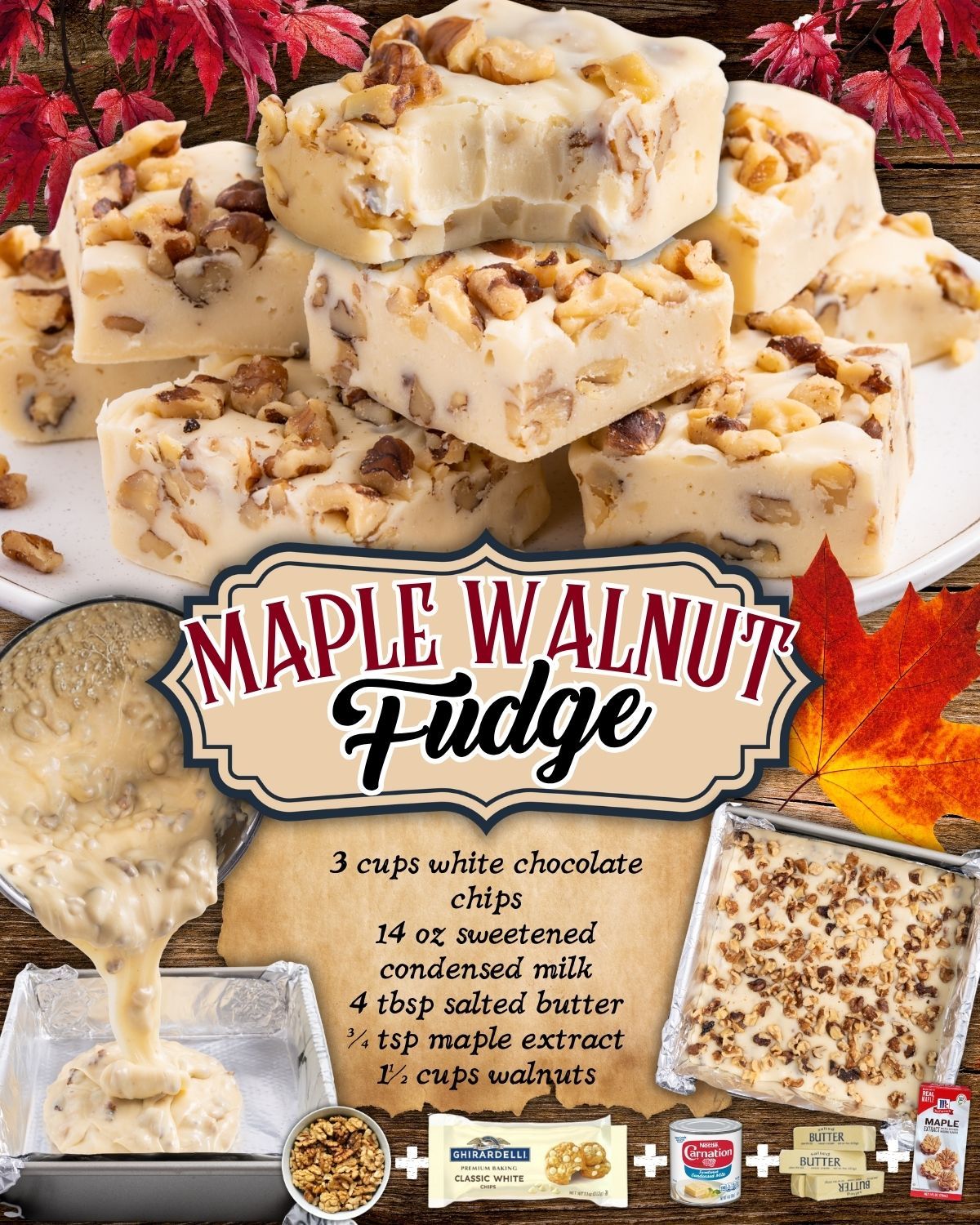
There are two main styles of maple walnut fudge. One is a shortcut version that melts white chocolate chips with sweetened condensed milk, then flavors the mixture with maple extract and folds in chopped walnuts before chilling it in a pan.
The other is a more traditional cooked fudge, where pure maple syrup, sugar, and dairy are boiled to a precise temperature, then beaten until thick and creamy and combined with walnuts before setting. Both approaches yield a dense yet creamy fudge studded with nuts, but the condensed‑milk versions are almost foolproof and very fast, while the cooked syrups deliver a deeper, old‑fashioned maple flavor.
Equipment
- 8‑ or 9‑inch square baking pan, lined with parchment or nonstick foil for easy removal.
- Medium to large saucepan or double boiler for melting chocolate and milk, or for boiling maple syrup mixtures in traditional recipes.
- Heatproof mixing bowl if using the microwave method with chocolate and sweetened condensed milk.
- Wooden spoon or heat‑safe spatula for stirring hot fudge mixtures.
- Candy thermometer, essential for traditional cooked maple fudge to reach the correct temperature (around 238–248°F, depending on recipe).
- Stand mixer or hand mixer for beating cooked fudge until thick and lighter in color.
- Knife and cutting board for chopping walnuts.
Ingredients
Here is a straightforward “easy” maple walnut fudge ingredient list using white chocolate and sweetened condensed milk.
- 2⅔ cups (16 oz / about 450 g) white chocolate chips or white confectionery coating.
- 1 can (14 oz / 396 g) sweetened condensed milk (not evaporated milk).
- 1½ teaspoons maple extract.
- Pinch of salt.
- 1½ cups (about 170 g) walnuts, coarsely chopped.
For a more traditional cooked maple walnut fudge using real maple syrup, a typical list looks like this.
- 2 cups (480 ml) pure maple syrup.
- 1¼ cups (250 g) granulated sugar or light brown sugar, depending on recipe.
- 1 cup (240 ml) heavy cream or evaporated milk.
- ¼ cup (½ stick / 57 g) unsalted butter.
- ½ teaspoon salt.
- 1 teaspoon vanilla extract and/or ½ teaspoon maple flavoring, to boost maple notes.
- 1–1½ cups (115–175 g) chopped walnuts, sometimes divided for mixing in and sprinkling on top.
Instructions and steps
For the easy sweetened‑condensed‑milk version, the process begins with preparing the pan so the fudge can be lifted out cleanly once set. An 8‑ or 9‑inch square pan is lined with parchment paper or nonstick foil, leaving some overhang as handles, and the lining is lightly greased if needed.
In a large microwave‑safe bowl, white chocolate chips and the can of sweetened condensed milk are combined, then microwaved on medium power for about 90 seconds.
After this initial heating, the mixture is stirred thoroughly so the residual heat melts the chips; if a few lumps remain, the bowl goes back into the microwave for short 15‑second bursts, with stirring between each, until smooth and fully melted.
Once the chocolate and condensed milk mixture is completely smooth, the flavorings go in. Maple extract and a pinch of salt are stirred into the hot fudge base, infusing it with maple aroma and balancing the sweetness.
Coarsely chopped walnuts are then folded through so they are evenly distributed; some recipes recommend toasting the walnuts lightly beforehand for extra flavor, but this is optional. The mixture is fairly thick at this stage and sets quickly as it cools, so it is poured or scraped into the prepared pan right away and spread into an even layer with a spatula, pressing it into the corners and smoothing the top.
The fudge pan is transferred to the refrigerator to chill until fully firm, usually several hours or overnight. Once set, the parchment or foil overhang is used to lift the slab out of the pan onto a cutting board.
A sharp knife, sometimes warmed in hot water and dried between cuts, is used to cut the fudge into small squares, typically about 25 pieces from an 8‑inch pan, though smaller bites are common because the fudge is quite rich.
The pieces can be stored in an airtight container at cool room temperature or in the fridge, where they keep well for days and are perfect for holiday candy trays and gift boxes.
The traditional maple walnut fudge method is more involved but gives a deeper maple character. It starts with lining an 8‑inch pan with parchment or foil, just as for the easy version. In a medium or large saucepan, maple syrup, sugar, cream (or evaporated milk), and salt are combined and heated over medium to medium‑high heat, stirring constantly until the sugar dissolves and the mixture comes to a boil.
Once boiling, a candy thermometer is attached to the side of the pan, making sure the bulb is submerged but not touching the bottom, and the mixture is cooked without stirring to the soft‑ball stage—usually around 238–248°F, depending on the specific recipe.
When the syrup reaches the target temperature, the pan is removed from the heat. Butter and vanilla or maple flavoring are added and gently stirred in. At this point, many recipes instruct you not to stir further until the mixture cools to about 110°F, which can take several minutes; this resting helps prevent premature crystallization.
Once the fudge base has cooled to the right temperature, it is beaten, either with a stand mixer’s whisk or paddle attachment or with a hand mixer, until the mixture thickens, lightens slightly in color, and loses its glossy shine—classic signs that fudge is about to set.
Just before it becomes too stiff to pour, chopped walnuts are folded in, reserving some to sprinkle on top if desired. The thickened fudge is quickly scraped into the prepared pan and smoothed into an even layer, then topped with the reserved walnuts, which adhere as it finishes setting.
The pan is left at room temperature or chilled briefly until the fudge is firm enough to cut. As with the easy version, it is lifted from the pan using the liner and cut into small squares with a sharp knife.
Variations
Maple walnut fudge can be adapted in several ways while keeping its signature flavors. Some recipes use a hybrid approach, combining maple syrup with sweetened condensed milk and white chocolate chips to get both deeper maple notes and the foolproof texture of condensed‑milk fudge.
Others incorporate marshmallow creme or miniature marshmallows into the hot mixture along with white chocolate and maple extract, which yields an especially creamy, smooth texture similar to popular “fantasy fudge” recipes.
Nut choices and treatments also vary. Walnuts are traditional, and toasting them beforehand in a dry skillet or oven can intensify their flavor and add crunch.
Some bakers swap in pecans or use a mix of walnuts and pecans for a more complex nut profile, while others reserve a generous handful of nuts to press onto the top of the fudge for a decorative, textured surface. For a slightly salted finish, a light sprinkle of flaky sea salt over the top before the fudge fully sets can enhance both the maple and nutty notes.
Sweetness and strength of flavor are easy to adjust as well. Using dark maple syrup (grade A dark or grade B) in cooked recipes intensifies the maple flavor, while adding a bit more maple extract in condensed‑milk versions boosts maple without affecting texture.
Some versions include a small amount of brown sugar along with white sugar to bring in caramel and molasses undertones that pair well with walnuts. Others drizzle melted white chocolate on top of the set fudge or swirl a little extra white chocolate into the mixture before it firms to create a marbled look.
No matter the variation, the hallmark of maple walnut fudge remains the same: a rich, creamy, maple‑forward fudge base packed with crunchy walnuts, cut into bite‑size squares that feel both nostalgic and indulgent on any holiday candy tray.