
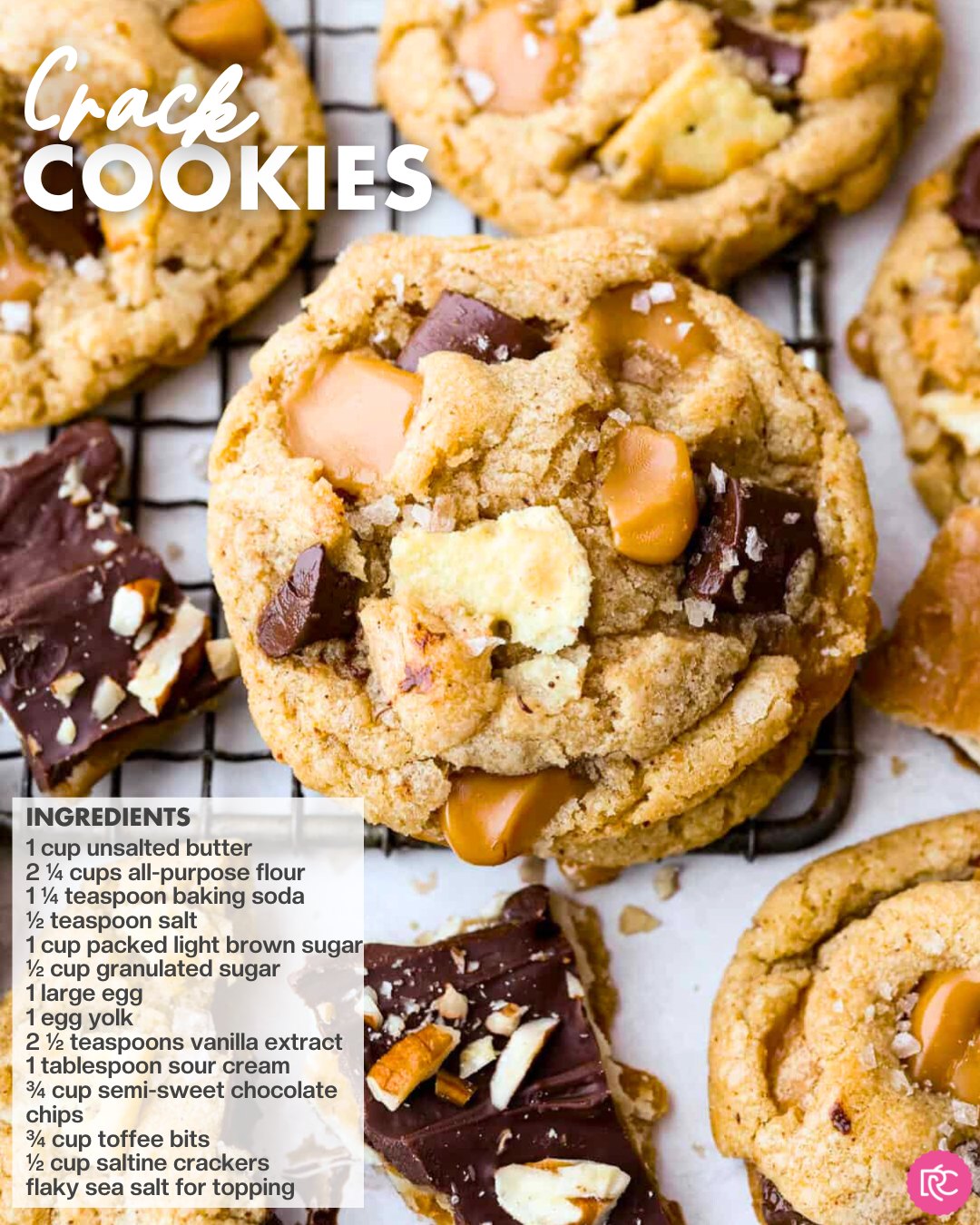
The core idea behind crack cookies is to take an already addictive candy—often saltine cracker toffee, sometimes called “Christmas crack”—and fold it into a buttery cookie dough. You start by making a quick tray of toffee bark with crackers, butter, and brown sugar, topped with melted chocolate, then chill and chop it into small pieces.
Those crunchy, caramelly shards (or similar “crack” like cornflake caramel clusters or pretzel‑chocolate bits) are stirred into a classic brown‑sugar cookie base, scooped, and baked into thick, chewy cookies studded with pockets of toffee, chocolate, and crunch.
Equipment
- Rimmed baking sheet for the crack/toffee layer.
- Saucepan for the butter–brown sugar toffee.
- Parchment paper or silicone baking mat.
- Mixing bowls for dry and wet ingredients.
- Hand mixer or stand mixer for the cookie dough.
- Standard baking sheets for baking the cookies.
Ingredients
For the crack/toffee layer (saltine‑style Christmas crack base):
- Saltine or Ritz crackers to cover a sheet pan in a single layer.
- Butter.
- Brown sugar.
- Chocolate chips for the melted chocolate topping.
For the cookie dough (chewy brown‑sugar base):
- All‑purpose flour.
- Baking soda and/or baking powder.
- Salt.
- Softened butter.
- Brown sugar and granulated sugar.
- Eggs.
- Vanilla extract.
- Chopped crack pieces (saltine toffee bark, cornflake crack clusters, or pretzel‑caramel‑chocolate chunks).
Optional mix‑ins seen across recipes:
- Extra chocolate chips (semi‑sweet, milk, or dark).
- Pretzels, roughly chopped, for extra salt and crunch.
- Cornflakes coated in a caramel mixture (“cornflake crack”).
- Soft caramels, tucked into the center of each dough ball for a gooey middle.
- Sea salt flakes for sprinkling on top.
Instructions and steps
Make the crack/toffee candy layer.
Line a rimmed baking sheet with parchment or a silicone mat and arrange a single layer of crackers to cover the whole surface, with edges touching but not overlapping. In a saucepan, melt butter and brown sugar together over medium heat, stirring until the butter melts and the mixture is uniform.
Bring it to a gentle boil and let it bubble for about 2–3 minutes until slightly thickened and caramel‑like. Immediately pour the hot toffee over the cracker layer and use a spatula to spread it evenly to the edges, working quickly before it sets.
Slide the pan into a preheated oven (typically 300–375°F, depending on your recipe) and bake just until the toffee layer is bubbling all over, usually 4–7 minutes. Remove from the oven and immediately scatter chocolate chips across the hot toffee. Let them sit for a few minutes to soften, then spread the melted chocolate into a smooth layer with an offset spatula.
Chill the tray in the refrigerator or freezer until the chocolate is hard and the whole slab is firm. When fully set, chop or break the candy into small bite‑size pieces—the more irregular, the more texture you’ll get inside the cookies.
Prepare the cookie dough.
Whisk the flour, leavening (baking soda and/or baking powder), and salt together in a medium bowl and set aside.
In a large bowl, use a hand mixer or stand mixer to cream softened butter with brown sugar and granulated sugar until the mixture is light, fluffy, and slightly paler in color. Beat in the eggs one at a time, followed by vanilla, mixing just until smooth.
Add the dry ingredients to the butter mixture in two or three additions, mixing on low speed until just combined, scraping down the bowl as needed. Avoid over‑mixing, which can develop gluten and make the cookies tough. The dough should be thick and scoopable.
Fold in the crack pieces and chill.
Gently fold most of the chopped crack candy into the dough with a spatula, distributing the pieces evenly so each scoop will have plenty of toffee and chocolate.
If you like a more loaded look, reserve a handful of crack chunks and extra chocolate chips to press on top of the cookies right before baking.
Cover the bowl and chill the dough in the refrigerator for at least 1–2 hours, or overnight for best flavor and texture. Recipes repeatedly emphasize this step: chilled dough spreads less, bakes thicker, and lets the crack pieces stay distinct instead of melting out into puddles.
Scoop and bake the cookies.
When ready to bake, preheat your oven (often 350°F) and line baking sheets with parchment or silicone mats.
Use a medium or large cookie scoop to portion the dough onto the prepared sheets, leaving room between balls for spreading. If you saved any crack bits or chocolate chips, press them into the tops of the dough balls now for a bakery‑style appearance.
Bake one sheet at a time until the edges are set and lightly golden and the centers still look slightly soft, usually around 10–12 minutes for standard cookies (adjusting based on size and oven). The cookies will continue to firm up as they cool.
Let them rest on the baking sheet for several minutes, then transfer to a wire rack to cool completely. The toffee and chocolate inside are very hot right out of the oven, so a brief cool on the pan helps them set and prevents breakage.
Variations
Christmas Crack Cookies:
Many recipes specifically brand these as “Christmas crack cookies,” sticking very closely to the classic saltine cracker toffee candy. You use saltines, butter, brown sugar, and chocolate chips for the crack, then fold those pieces into a simple cookie dough; festive sprinkles or holiday M&Ms pressed on top give a seasonal look.
Cornflake Crack Cookies:
Instead of cracker toffee, some bakers use “cornflake crack”—cornflakes coated in a caramel or butterscotch mixture—as the crunchy, addictive mix‑in. Those cornflake clusters are cooled, chopped, and stirred into the dough, producing crack cookies with a lighter, shatteringly crisp crunch and a cereal‑bar vibe.
Pretzel‑Toffee Crack Cookies:
Another variation keeps the saltine toffee but adds pretzels to the cookie dough for extra salty crunch. Some recipes tuck soft caramel pieces in the center of each dough ball so that when baked, the cookie has a gooey caramel middle surrounded by bits of toffee, chocolate, and pretzel. This pushes the sweet‑salty contrast even further, edging into candy‑bar cookie territory.
Gluten‑Free Crack Cookies:
Gluten‑free versions swap the crackers for gluten‑free saltines or gluten‑free graham‑style crackers and use a gluten‑free flour blend in the dough.
The process stays essentially the same: make crack candy on a lined sheet, cool and chop, then fold into a gluten‑free cookie base. Because gluten‑free doughs can spread differently, some recipes recommend slightly longer chilling and testing one cookie first to adjust bake time.
Flavor Twists:
Once you understand the base method, you can twist the flavors in several directions. White chocolate chips plus macadamias and salted Ritz cracker toffee create a blond, butterscotch‑leaning crack cookie. Dark chocolate and espresso powder in the dough skew more grown‑up and bitter‑sweet.
A sprinkle of flaky sea salt on top, frequently used in saltine toffee bark and crack cookies, sharpens the contrast and keeps the cookies from feeling cloying despite their richness.
Crack Cookies are more of a concept than a single rigid recipe: combine a crunchy, salty‑sweet “crack” candy with a chewy cookie base, chill, and bake until just set, and you get thick, loaded cookies that are almost impossible to stop eating—perfect for holidays, bake sales, and any time you want a cookie that feels like a full‑on dessert bar in one bite.