
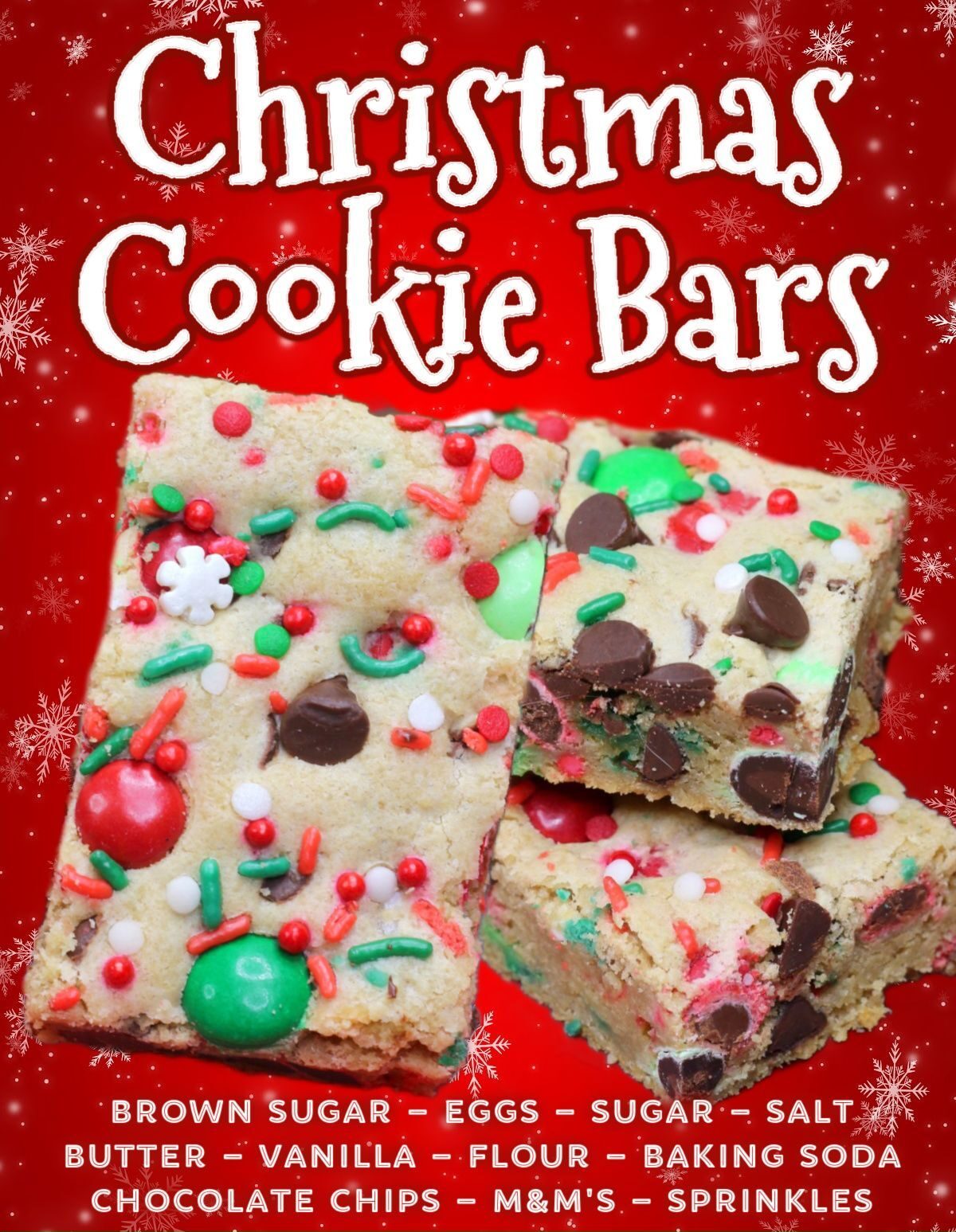
Most Christmas cookie bar recipes start with a simple blondie‑style or chocolate chip cookie dough base: melted or softened butter is mixed with brown sugar and granulated sugar, then eggs and vanilla are beaten in for richness and structure. Flour, baking soda or baking powder, salt, and sometimes cornstarch or a little cinnamon are folded in to create a thick, scoopable dough that bakes up soft and chewy rather than cakey.
Finally, holiday M&M’s, chocolate chips, and Christmas sprinkles (or other mix‑ins like pretzels and Oreos) are stirred through, the dough is pressed into a 9×13‑inch pan, and it’s baked until the edges are set and the center is just done. Some versions are topped with a thick layer of vanilla buttercream and more sprinkles once cooled, turning them into frosted sugar cookie bars with a high frosting‑to‑cookie ratio.
Equipment
- 9×13‑inch baking pan (or similar) lined with parchment and lightly greased.
- Mixing bowls for wet and dry ingredients.
- Hand mixer or stand mixer (or sturdy whisk and spatula) for making the dough.
- Measuring cups and spoons.
- Offset spatula or rubber spatula for spreading dough evenly in the pan and smoothing frosting if using.
Ingredients
A typical Christmas cookie bar base looks like this, with mix‑ins and frosting making it “Christmas.”
- ¾–1 cup unsalted butter, melted or softened.
- 1–1¼ cups packed light or dark brown sugar.
- ½ cup granulated sugar.
- 1–2 large eggs (many recipes use 2 eggs, some add an extra yolk for chewiness).
- 2–3 teaspoons vanilla extract.
- 2–2¼ cups all‑purpose flour.
- ½–1 teaspoon baking soda and/or ½ teaspoon baking powder.
- ½–¾ teaspoon salt.
- 1 tablespoon cornstarch (optional, for extra soft, thick bars).
- 1–1½ cups Christmas M&M’s and/or holiday‑colored chocolate candies.
- ½–1 cup chocolate chips (semi‑sweet, milk, or white).
- 2–4 tablespoons Christmas sprinkles mixed into or scattered on top of the dough.
For frosted Christmas sugar cookie bar versions, a simple buttercream topping is common:
- ½–1 cup softened butter.
- 1½–2¼ cups powdered sugar.
- 1–3 tablespoons milk or cream.
- 1–2 teaspoons vanilla extract and a pinch of salt.
- More Christmas sprinkles for the top.
Instructions and steps
To make Christmas cookie bars, start by preparing the pan and oven. Line a 9×13‑inch baking pan with parchment paper, leaving some overhang on the long sides as “handles” so you can lift the whole slab out after baking; lightly grease if your recipe suggests it. Preheat the oven, typically to 325–350°F (160–180°C), depending on the specific recipe.
Mix the wet ingredients first. In a large bowl, whisk or beat together the melted or softened butter with the brown sugar and granulated sugar until the mixture looks smooth and slightly lighter in color. Add the eggs and vanilla extract and beat again just until combined and glossy; over‑beating at this stage can incorporate too much air and make the bars cakier rather than chewy.
In a separate bowl, whisk the dry ingredients: flour, baking soda and/or baking powder, salt, and cornstarch if using.
Stir the dry mixture into the wet mixture in two or three additions, mixing on low speed or by hand until a thick dough forms with no streaks of dry flour. The dough should be quite thick and slightly sticky, similar to standard cookie dough.
Fold in the festive mix‑ins. Gently stir in most of the Christmas M&M’s, chocolate chips, and some of the sprinkles, reserving a handful of M&M’s and sprinkles to press on top of the dough for a prettier surface.
Spread the dough evenly into the prepared pan using a spatula or your fingers, pressing it into a level layer all the way to the edges and corners. Scatter the remaining M&M’s and sprinkles over the top and press them lightly into the surface so they adhere during baking.
Bake the bars until set at the edges and just done in the center. Most recipes bake at 325–350°F for about 20–35 minutes, depending on oven and thickness, until the edges are lightly golden and a toothpick inserted near the center comes out with a few moist crumbs but no raw batter.
Over‑baking will make the bars dry and cake‑like, so it’s better to pull them when the middle still looks slightly soft; they continue to set as they cool.
Let the pan cool completely on a wire rack before cutting, especially if you plan to frost the bars. For frosted sugar cookie bar versions, prepare the buttercream while the bars cool: beat softened butter until creamy, then gradually mix in powdered sugar, vanilla, and just enough milk or cream to make a spreadable frosting.
Spread the frosting in an even, thick layer over the cooled cookie bar slab, then shower with more Christmas sprinkles for a colorful top. For unfrosted bars, you can simply cut and serve once cool. Use the parchment handles to lift the whole block out of the pan, transfer to a cutting board, and cut into squares or rectangles with a sharp knife, wiping the blade between cuts for cleaner edges.
Tips and tricks
Many Christmas cookie bar recipes note that using melted butter plus more brown sugar than white sugar leads to denser, chewier bars with a caramel‑like flavor, which works well with chocolate and M&M’s. If the dough seems greasy or too thin after mixing, chilling it briefly before baking or adding a small extra handful of flour can help it firm up, but most bar recipes are designed to be baked immediately.
Pressing extra M&M’s and sprinkles on top before baking ensures a festive, bakery‑style look instead of having all the candy hidden inside.
For very clean cuts, especially on frosted bars, chill the baked and frosted pan for a bit so the frosting firms up slightly, then use a long, sharp knife to slice straight down rather than sawing back and forth.
Baking time is one of the biggest variables: different pans, oven temperatures, and dough thicknesses mean you should start checking several minutes before the earliest suggested time and rely on visual cues—golden edges, set top, and a soft but not jiggly center.
Under‑baked bars can sink or taste raw in the center, while over‑baked ones lose that special soft chew, so that sweet spot is key.
Christmas cookie bars also store and travel better than individual cookies in many cases. Most sources say they keep well for several days in an airtight container at room temperature, and frosted sugar cookie bars can be refrigerated if your kitchen is warm. Because they’re baked and served in one pan, they’re easy to transport to parties or bake sales, and they slice neatly into portions for cookie trays or gift boxes.
Variations
“Christmas cookie bars” is really a category rather than a single recipe, and there are plenty of ways to vary the base to create different holiday flavors and textures.
One common spin is “loaded” Christmas cookie bars, where the dough is packed with not just M&M’s and chocolate chips but also chopped Oreos, mini pretzel twists, and extra sprinkles, giving each bite salty‑sweet crunch and lots of texture. These bars lean into the “everything but the kitchen sink” style and are especially popular for feed‑a‑crowd trays and party desserts.
Sugar cookie‑style Christmas bars put more focus on a pale, buttery, vanilla‑forward base and a thick buttercream topping rather than mix‑ins. The bars are often lightly flavored with almond extract or extra vanilla, baked just until set for a soft bite, then covered with pastel or bright frosting and sprinkles.
These work well when you want the look and flavor of decorated sugar cookies without rolling, cutting, and piping dozens of shapes.
There are also more gourmet takes, such as dulce de leche cookie bars or “magic” cookie bars tweaked for Christmas. Dulce de leche bars layer a shortbread crust, a thick caramelized milk (dulce de leche) center, and a chocolate top, offering a more decadent, candy‑bar‑like cookie bar that’s ideal for holiday dessert plates.
Christmas magic bars use a graham cracker crust and sweetened condensed milk base topped with oats, assorted baking chips, and holiday M&M’s. While visually different from classic M&M cookie bars, they’re frequently included on Christmas cookie bar roundups because they slice cleanly into squares for sharing.
Finally, you can easily adapt basic Christmas cookie bars for other holidays or themes by changing the candy colors and sprinkle shapes. Valentine’s versions use pink and red M&M’s and heart sprinkles, Easter versions swap in pastel candies, and year‑round bars use rainbow or team‑color sprinkles.
The underlying formula—one pan, chewy cookie base, built‑in decorations—stays the same, making Christmas cookie bars a flexible, high‑impact treat that fits wherever a fun, fuss‑free dessert is needed during the holidays.