
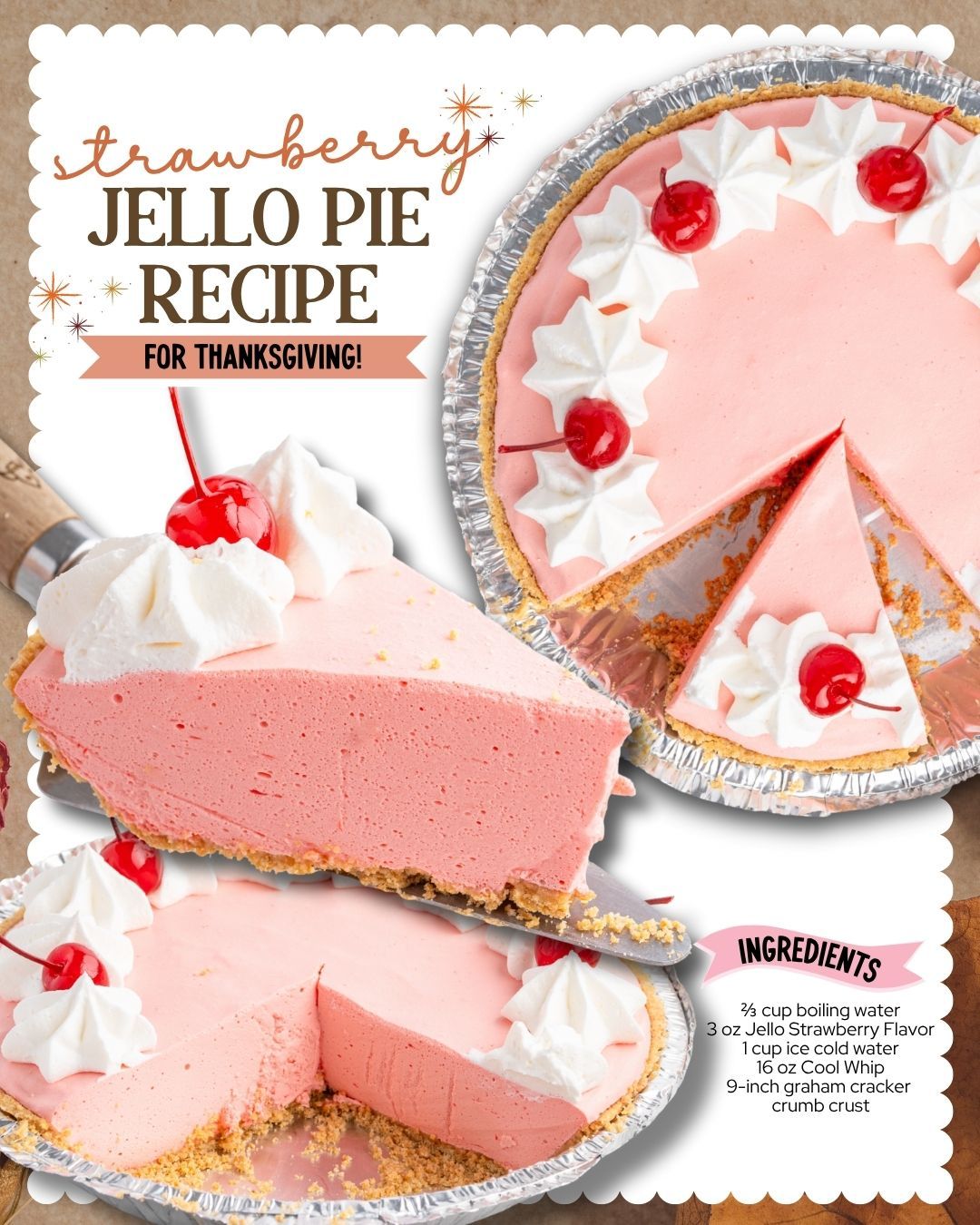
Strawberry Jello Pie is built on a very simple concept: use flavored gelatin and whipped topping to create a stabilized, airy filling that sets up in the fridge instead of the oven. A packet of strawberry Jell‑O gets dissolved in boiling water, then rapidly cooled with ice water, which thickens it just enough to cling to other ingredients.
Thawed Cool Whip is then folded into the cooled gelatin to form a smooth, pale‑pink mousse, and many versions fold in chopped fresh strawberries for bursts of real fruit. That mixture is poured into a graham cracker crust, chilled for several hours until firm, and finished with more whipped topping and berries on top, creating a pie that tastes like a cross between strawberry mousse, icebox dessert, and classic diner Jell‑O pie.
Equipment
- Large mixing bowl for dissolving the Jell‑O and mixing the filling.
- Heatproof measuring cup or pitcher for boiling water.
- Measuring cups for cold water, ice, and chopped strawberries.
- Whisk to dissolve the gelatin completely and incorporate ice water smoothly.
- Rubber spatula for folding in Cool Whip and fresh berries without deflating the mixture.
- Premade graham cracker crust (9–10 inch) with foil pan and plastic dome, or a homemade graham crust set in a pie plate.
- Knife and cutting board for hulling and chopping strawberries.
- Refrigerator space with a level shelf to chill the pie for several hours until firm.
- Optional hand mixer if you want to slightly whip the Cool Whip with the gelatin, though most recipes use a whisk and spatula.
Ingredients
- 1 package (3 oz / 85 g) strawberry Jell‑O gelatin mix.
- ⅔ cup (160 ml) boiling water.
- 1 cup (240 ml) ice water, made from cold water plus ice cubes to equal 1 cup total.
- 1 tub (8 oz / 226 g) Cool Whip or similar whipped topping, thawed in the refrigerator.
- 2 cups (about 300 g) fresh strawberries, hulled and diced or sliced small.
- 1 premade graham cracker crust (9–10 inch).
- Extra Cool Whip and additional fresh strawberries for decorating the top (optional but recommended).
Many recipes note that using a full 3‑oz box of strawberry Jell‑O to about ⅔ cup boiling water and 1 cup ice water yields the right firmness for a sliceable, yet creamy pie, and an 8‑oz tub of whipped topping gives enough volume to fill a standard graham crust generously.
Instructions and steps
Making a strawberry Jello pie centers on properly dissolving the gelatin and then cooling it to the right stage before adding whipped topping and berries. The process begins by pouring the dry strawberry Jell‑O powder into a large mixing bowl.
Boiling water, measured to about two‑thirds of a cup, is poured over the powder, and the mixture is whisked steadily for about two minutes until all granules are dissolved and the liquid looks clear and uniformly red with no undissolved sugar at the bottom of the bowl. This step is important because any undissolved gelatin can leave rubbery bits in the finished pie.
Next, the hot gelatin mixture is rapidly cooled with ice water. One cup of ice water is prepared by combining cold water and ice cubes in a measuring cup until it reaches the one‑cup mark, then poured into the dissolved gelatin.
The mixture is whisked again until the ice melts and the liquid feels cool and slightly thickened. If any ice chunks remain, they are removed so the final water amount remains accurate. This quick‑chill step helps bring the gelatin down to a temperature where it can be combined with whipped topping without melting it, and it also kick‑starts the setting process so the filling will firm up in a reasonable time in the fridge.
Once the gelatin mixture is cool and lightly syrupy rather than hot and watery, the whipped topping is added. Thawed Cool Whip is spooned into the bowl and gently whisked or folded until the mixture turns a light, opaque pink and no streaks of red gelatin or white topping remain.
At first it may look lumpy, but continued gentle mixing smooths it into a mousse‑like texture. Some recipes recommend switching from a whisk to a rubber spatula at this stage to avoid deflating the topping too much; the goal is to keep the filling airy while fully combining the ingredients.
With the base filling made, the fresh strawberries are folded in. The berries should be hulled and diced or chopped into small pieces so they distribute evenly in the filling and slice cleanly later. About two cups of prepared strawberries are added to the pink mixture and gently stirred in with a spatula until they are evenly dispersed.
Some bakers reserve a handful of chopped or sliced berries to decorate the top of the pie later, while others mix all of them in for a fruit‑heavy filling. If the strawberries are particularly juicy, patting them dry with a paper towel before folding in helps avoid excess liquid that could soften the set.
Now the pie can be assembled. The graham cracker crust, either premade in its foil pan or homemade and cooled, is placed on a level surface. The strawberry Jell‑O filling is poured or spooned into the crust, using a rubber spatula to scrape the bowl clean and smooth the top of the filling.
Many recipes mention that the filling will mound slightly in the center above the crust’s rim, which is fine as long as the crust is sturdy; smoothing the top in concentric circles gives a neat, bakery‑style look. If using a store‑bought crust with a plastic dome, the dome can be inverted and used as a lid, giving the pie protection in the fridge.
The pie then needs to chill until fully set. It is placed in the refrigerator, not the freezer, for at least three to four hours, though overnight chilling is often recommended for the cleanest slices and best texture. During this time, the gelatin continues to firm up and the whipped topping stabilizes, transforming the loose filling into a sliceable, yet soft, mousse‑like layer.
It is important that the pie sit on a level shelf so it sets evenly without sloping to one side. Most sources caution against cutting too soon; if the center is still jiggly or the knife drags through the filling, it needs more time.
Once the pie is firm, it can be decorated and served. Many recipes call for spreading or piping an extra layer or border of Cool Whip on top, then piling sliced strawberries in the center or around the edges for a bright, fresh garnish. Some bakers drizzle a little strawberry sauce or warmed jam on top of the berries for extra shine and flavor.
When slicing, a sharp knife that is wiped clean between cuts gives the neatest wedges and keeps the layers looking distinct. The pie is best served very cold, straight from the fridge, and leftovers should be kept chilled; the filling generally stays stable for a couple of days, though the crust gradually softens as it absorbs moisture.
Variations
Strawberry Jell‑O pie has inspired many variations that tweak the filling while using the same basic gelatin‑and‑whipped‑topping technique. Some versions introduce dairy for extra richness and tang by blending cream cheese, Greek yogurt, or sweetened condensed milk into the gelatin mixture before adding whipped topping.
A common approach is to beat softened cream cheese with a bit of sugar, then whisk in the cooled gelatin and finally fold in Cool Whip, yielding a thicker, cheesecake‑like filling that still sets without baking. Other recipes stir in sweetened condensed milk with the dissolved gelatin so the filling becomes extra creamy and sweet, tasting more like a strawberry cream pie than pure Jell‑O.
There are also pies that emphasize fresh fruit more than mousse. In those, the crust is filled with whole or halved strawberries, arranged tightly with cut sides down, and a cooked mixture of water, sugar, cornstarch, and a small amount of strawberry Jell‑O is poured over the berries.
As this glaze chills, it sets into a clear, gelled layer that suspends the strawberries, resulting in a pie where the berries remain the main texture and the Jell‑O acts more like a shiny coat. This version slices more like a fresh fruit tart and less like a mousse pie but still uses gelatin for stability.
Flavor variations are as simple as swapping the gelatin. Recipes often mention using raspberry, cherry, lime, or mixed‑berry Jell‑O in place of strawberry to create similar no‑bake pies in different flavors, sometimes matching the fruit added into the filling.
A lime Jell‑O and whipped topping mix poured into a graham crust becomes a key‑lime‑style Jell‑O pie, while raspberry Jell‑O with fresh raspberries turns the dessert into a raspberry cream pie with the same easy method. Some “3‑ingredient Jello pie” versions omit fruit entirely, relying solely on flavored gelatin, ice water, and whipped topping in a crust for a very smooth, airy texture.
Toppings also vary. Beyond Cool Whip and berries, some bakers grate white or milk chocolate over the top, use chocolate cookie crusts instead of graham for a chocolate‑covered‑strawberry vibe, or swirl a little strawberry jam through the top of the filling before it sets for a marbled look.
Others add a thin layer of plain whipped topping first, then set sliced strawberries in decorative patterns or even use whole berries with their stems for a more dramatic presentation.
Despite these variations, the core technique remains the same: dissolve flavored gelatin, cool quickly with ice water, fold in something creamy and often fresh fruit, pour into a crumb crust, and chill until firm. That simple process is what makes Strawberry Jello Pie and its cousins reliable, low‑stress desserts that deliver a nostalgic, summery flavor with very little time in the kitchen.