
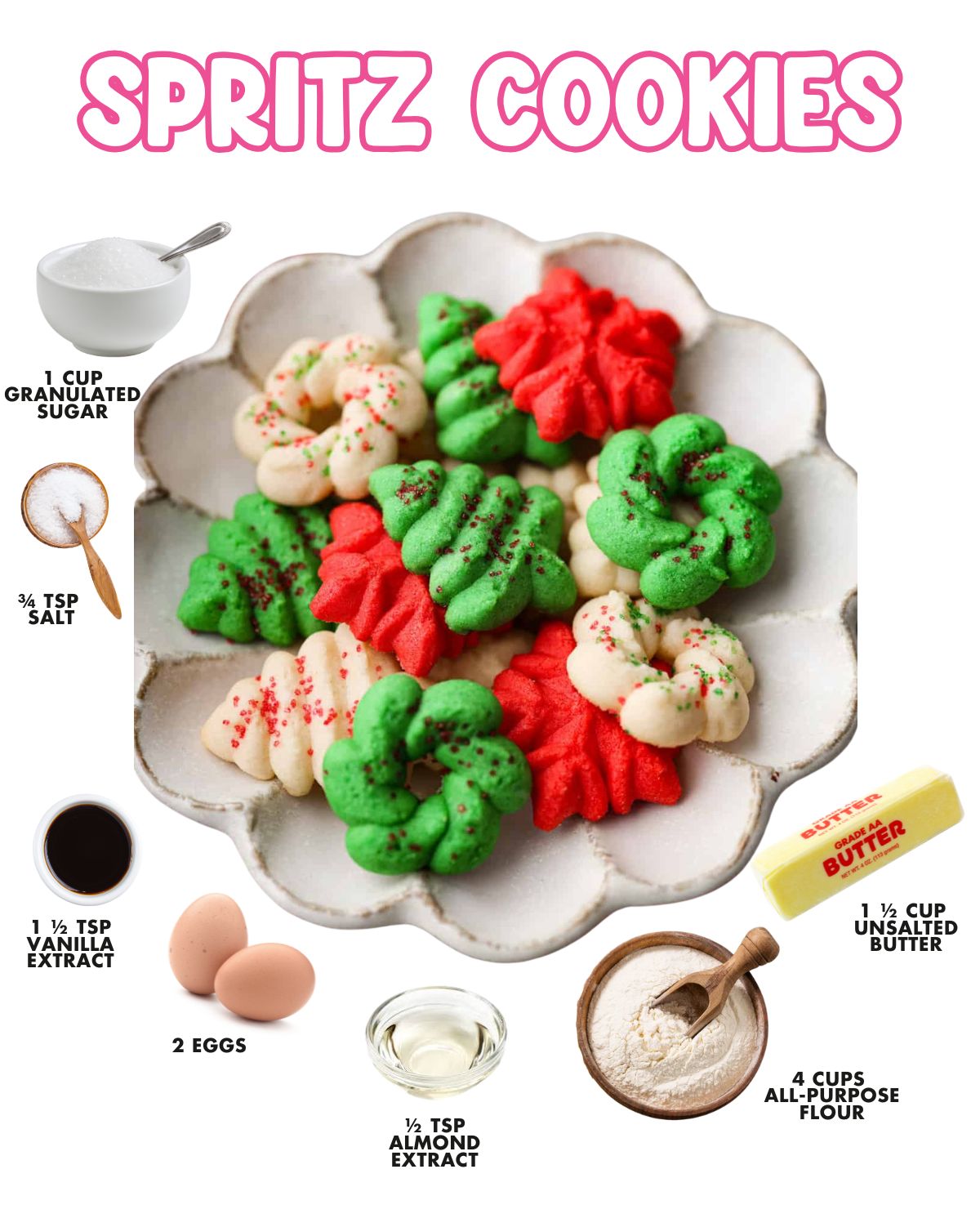
Spritz Cookies are classic buttery Christmas cookies made from a rich, simple dough that’s pressed through a cookie press into delicate shapes, then baked until just set and topped with sprinkles, sanding sugar, or a drizzle of chocolate. They’re tender, slightly crisp at the edges, and hold their intricate designs beautifully, making them a favorite for cookie trays, gift boxes, and holiday baking with kids.
What are Spritz Cookies?
Spritz cookies are buttery press cookies with a dough that’s similar to sugar cookies or shortbread but usually includes an egg so the cookies hold their shape instead of crumbling. The soft dough is loaded into a cookie press, then “spritzed” directly onto ungreased or unlined baking sheets through different discs to create flowers, wreaths, trees, stars, and more. Because the dough doesn’t spread much, the shapes stay crisp and defined, and you can fit a lot of small cookies on each tray.
The flavor is all about butter, vanilla, and often almond extract, with a fine, tender crumb that’s dense rather than airy. They’re traditionally tinted with food coloring and decorated with sprinkles or a simple glaze for Christmas, but the base recipe works year‑round by swapping shapes and colors for different occasions.
Equipment
- Cookie press with assorted discs
- Large mixing bowl
- Hand mixer or stand mixer with paddle attachment
- Measuring cups and spoons
- Rubber spatula for scraping the bowl
- Light‑colored metal baking sheets (ungreased; avoid parchment or silicone so dough sticks to the sheet)
- Cooling racks
- Small bowls and spoons for sprinkles, colored sugar, and optional glaze
Ingredients
Base buttery spritz cookie dough:
- 1 cup (2 sticks / 226 g) unsalted butter, softened to room temperature
- ¾ cup (150 g) granulated sugar
- 1 large egg, at room temperature
- 1 teaspoon pure vanilla extract
- 1 teaspoon almond extract (or use all vanilla if preferred)
- 2¼–2⅓ cups (about 280–295 g) all‑purpose flour, spooned and leveled
- ½ teaspoon fine salt
Decorating and optional variations:
- Gel food coloring (red, green, or desired colors), optional
- Colored sanding sugar, nonpareils, or holiday sprinkles
- Mini chocolate chips or chocolate candies to press in the centers, optional
- 1 cup (120 g) powdered sugar + 2–3 tablespoons milk or cream for a simple glaze, optional
- ½ cup (85 g) melted chocolate for drizzling, optional
Step-by-step instructions
Spritz cookie dough comes together quickly in one bowl and does not require chilling, which makes it especially convenient for holiday baking. To start, the oven is preheated to around 350–400°F (175–200°C), depending on your preferred recipe; many modern bakers favor 350–375°F for even browning, while some classic formulas bake at 400°F for a little extra snap.
Baking sheets are left ungreased and unlined so the dough can grip the metal surface when pressed; parchment or silicone mats are usually avoided because they’re too non‑stick and can keep the cookies from releasing cleanly from the press.
The dough begins with properly softened butter. In a large bowl, butter and granulated sugar are beaten together with a hand mixer or stand mixer on medium to medium‑high speed until the mixture is smooth, lighter in color, and fluffy, usually 2–4 minutes.
This creaming step incorporates a bit of air and ensures the sugar starts to dissolve into the butter, which helps the cookies bake evenly and develop a delicate texture. Once the butter and sugar are well combined, the egg is added along with the vanilla and almond extracts. The mixture is beaten again until everything is fully incorporated and the batter looks creamy and slightly thick.
Next, the dry ingredients are added. Flour and salt are either whisked together separately or added directly to the bowl, then mixed on low speed just until combined. At this point the dough will be soft and thick, but not sticky or loose; it should be stiff enough to hold its ridges once it’s pressed, yet pliable enough to move through the cookie press.
If the dough seems too soft and greasy, a tablespoon or two more flour can be added; if it’s crumbly and dry, a teaspoon or so of milk can help bring it together. Some bakers divide the dough and tint portions with gel food coloring—red, green, or any festive shade—mixing just until the color is even.
Once the dough is ready, the cookie press is assembled according to the manufacturer’s directions, choosing a disc shape such as a flower, wreath, tree, or star. Portions of dough are loaded into the press cylinder, making sure there are no large air pockets.
A cool, unlined baking sheet is placed on the counter, and the cookie press is held perpendicular to it. The trigger is pressed to extrude the dough directly onto the sheet; each click should release one cookie, leaving the shaped dough behind when the press is lifted straight up.
As cookies are pressed onto the baking sheet, they are spaced about an inch apart, but they can be fairly close together because they spread very little. At this point any decorations—sprinkles, colored sugar, or a single mini chocolate chip in the center—are added, gently pressing them onto the surface so they adhere.
If the dough warms up and becomes too soft while pressing lots of trays, it can be briefly chilled in the press or the shaped cookies can be chilled on the tray for a few minutes to firm up before baking, which helps them hold their detail.
The trays go into the preheated oven and bake until the cookies are just set and very lightly golden at the edges, typically 6–10 minutes depending on size, thickness, and oven temperature. They should not brown deeply; the goal is a pale, buttery cookie with only a hint of color around the edges. The cookies rest on the baking sheet for a few minutes to firm up, then are transferred with a thin spatula to a wire rack to cool completely.
Once cool, spritz cookies can be enjoyed as is, or finished with a simple glaze or drizzle of melted chocolate. A glaze made by whisking powdered sugar with a little milk can be used to dip or drizzle over the cookies, finishing with an extra sprinkle of decorating sugar if desired. Alternatively, melted chocolate can be drizzled over the tops or used to dip one end of each cookie for a half‑dipped look.
Texture and flavor tips
The hallmark of a good spritz cookie is a rich buttery flavor and a crisp‑tender texture that breaks cleanly rather than crumbling like shortbread. Using real butter—not margarine or shortening—is essential for both flavor and the right mouthfeel.
Butter should be softened but still cool to the touch; if it’s too melty, the dough can be greasy and the cookies may lose their shape. The combination of vanilla and almond extract is classic and gives spritz cookies their nostalgic holiday bakery taste, but the almond can be reduced or omitted if a pure vanilla profile is preferred.
Dough consistency is the main success factor for getting clean shapes from a cookie press. The dough must be soft enough to push through the disc but firm enough to stay put once on the baking sheet.
If shapes are not sticking to the sheet, it’s often because the pan is too warm, too greasy, or lined with non‑stick material; switching to a cool, ungreased metal sheet usually solves the problem. Overmixing once the flour is added can make the cookies tougher, so it’s best to mix just until the flour disappears.
Because spritz cookies are small, they can go from perfect to over‑baked quickly. Keeping a close eye on the first tray and noting the exact time when the edges just start to turn light gold helps set the timing for the rest of the batches. Rotating pans halfway through baking can also promote even coloring if your oven has hot spots.
Variations and decorating ideas
Once the base spritz dough is mastered, variations are almost endless. Coloring portions of the dough with red and green gel makes festive wreaths, trees, and flowers for the holidays. Citrus lovers can swap the almond extract for lemon or orange extract and add a teaspoon of citrus zest for a bright twist.
A cocoa version can be made by replacing a portion of the flour with unsweetened cocoa powder to create chocolate spritz cookies, which pair beautifully with peppermint or orange glazes.
Decorating can be as simple or elaborate as you like. Before baking, cookies can be topped with colored sanding sugar, nonpareils, or tiny candies, which bake into the surface and stay vibrant. After baking and cooling, cookies can be dipped in glaze and then in sprinkles, or drizzled with white, dark, or colored candy melts. For a more understated look, a light dusting of powdered sugar over cooled cookies gives a “snowy” finish.
Shapes can change with the seasons: hearts and flowers for spring, pumpkins and leaves for autumn, and basic stars or shells for everyday coffee cookies. If you don’t have a cookie press, some recipes provide directions to pipe the dough with a star‑tip piping bag into rosettes or short logs, giving a similar effect.
Make-ahead, storage, and gifting
Spritz cookies are ideal for make‑ahead baking because the dough doesn’t require chilling and the baked cookies keep their quality for several days. Stored in an airtight container at room temperature, they typically stay fresh for about a week, especially if kept away from heat and humidity. Layers of cookies can be separated by parchment or wax paper to protect decorations and prevent sticking.
The cookies also freeze very well. Once fully cooled, they can be frozen in airtight containers or freezer bags for several weeks or more; thawing at room temperature keeps their texture intact.
Some bakers prefer to freeze them undecorated and add glaze or chocolate drizzle after thawing, while others freeze them fully decorated with sprinkles and find they hold up nicely for holiday trays and gifting.
Because they’re small, sturdy, and not overly fragile, spritz cookies ship and travel better than many frosted cookies, making them a favorite choice for cookie boxes and care packages. Packed snugly in tins or boxes with tissue or parchment, they arrive looking just as pretty as when they left your kitchen. For many bakers, a big assortment of spritz cookies—colored, glazed, chocolate‑dipped, and sprinkled—is the centerpiece of the annual Christmas cookie platter.