
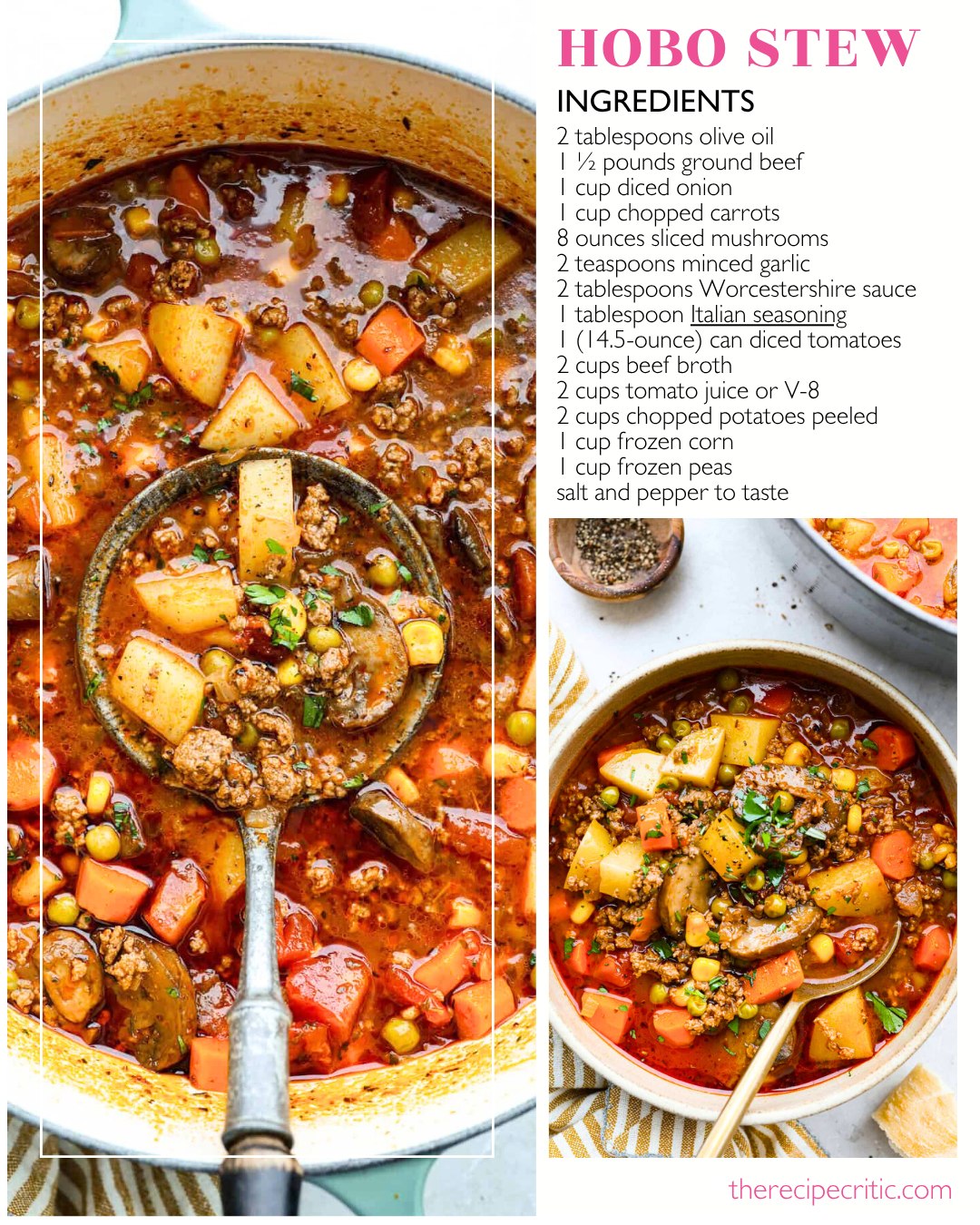
Hobo stew is a thick, hearty ground beef and vegetable stew cooked in a tomato‑based broth, usually built from pantry staples like canned tomatoes, broth, potatoes, carrots, corn, and beans. It’s sometimes called Mulligan stew or hamburger stew and is famous for being budget‑friendly, easy to stretch for a crowd, and cozy enough to feel like a full meal in a bowl.
What is Hobo Stew?
Hobo stew is essentially a hamburger‑vegetable soup that leans thick like a stew, with plenty of chunky vegetables and a rich, tomato‑forward broth. It traditionally uses ground beef, though some versions swap in stew meat or mixed meats, and almost always includes potatoes, carrots, onion, and celery simmered together until everything is tender.
Many recipes add canned or frozen vegetables such as corn, green beans, peas, or beans, making it a great “clean out the pantry and fridge” recipe where almost any vegetable can find a home in the pot.
The broth typically starts with beef stock or broth plus canned tomatoes, tomato sauce, or even tomato juice, sometimes boosted with Worcestershire sauce, herbs, and seasoning blends for depth. The result is a savory, slightly tangy, tomato‑beef flavor that’s familiar and kid‑friendly, often compared to a homemade version of condensed vegetable beef soup—but with bigger chunks and more personality. Because it’s a one‑pot meal that feeds a lot of people cheaply, it shows up at camps, church suppers, and weeknight dinners alike.
Equipment
- Large Dutch oven or soup pot (5–7 quart) for browning beef and simmering the stew
- Wooden spoon or spatula for breaking up ground beef and stirring
- Cutting board and sharp knife for chopping onions, potatoes, carrots, celery, and other vegetables
- Measuring cups and spoons for broth, tomato products, seasonings, and sauces
- Can opener for tomatoes, beans, corn, and other canned vegetables
- Ladle for serving
- Optional slow cooker if you want to transfer browned beef and ingredients for long, hands‑off cooking
- Optional heavy‑duty foil and tongs if you’re making campfire “hobo stew” packets directly over coals
Ingredients
Hobo stew is very flexible, but most versions share the same core building blocks: ground beef, onion, mixed vegetables, potatoes, tomatoes, and broth.
- 1–2 tablespoons olive oil or vegetable oil, if needed for browning
- 1–1½ pounds ground beef (80–90% lean)
- 1 medium onion, diced
- 2–3 carrots, peeled and sliced or diced
- 2–3 ribs celery, diced (optional but common)
- 2–4 cloves garlic, minced
- 3–4 cups potatoes, peeled and cut into bite‑size cubes (often russet, Yukon gold, or red)
- 1 can (14.5–28 oz) diced tomatoes with their juice (size and number of cans vary by recipe)
- 1 can (8–15 oz) tomato sauce or 1–2 cups tomato juice, depending on how tomato‑rich you prefer the broth
- 4–6 cups beef broth or stock, or a mix of beef and vegetable broth
- 1–2 teaspoons Worcestershire sauce for savory depth
- 1–2 teaspoons Italian seasoning or dried herb blend (thyme, oregano, parsley)
- 1–2 teaspoons salt, plus more to taste
- ½–1 teaspoon black pepper
- ½ teaspoon smoked paprika, Cajun seasoning, or chili powder (optional, for gentle heat and smokiness)
- 1–2 cups frozen mixed vegetables (corn, green beans, peas, etc.) OR individual canned veggies like green beans, corn, peas, or beans, drained
- 1 can baked beans or other beans (optional, common in simple 4‑ingredient versions)
- 1–2 teaspoons beef bouillon or “Better Than Bouillon” (optional, for extra richness)
- Shredded cheddar cheese or grated Parmesan for topping (optional)
Step-by-step instructions
Hobo stew is a classic one‑pot meal that comes together in a few straightforward stages: brown the meat, build the flavor base, add vegetables and liquids, then simmer until thick and hearty. The exact process changes slightly from recipe to recipe, but the rhythm is very similar.
Most versions start by browning the ground beef. A large Dutch oven or soup pot is set over medium to medium‑high heat and a small amount of oil is added if the beef is very lean. Ground beef goes into the hot pot and is broken up with a spoon as it cooks, stirring until it’s no longer pink and beginning to brown on the edges; some recipes aim for a bit of caramelization to build flavor.
Excess grease is drained off, or, in some heartier styles, just spooned away partially so some fat remains to sauté the vegetables.
Once the meat is browned, aromatics and base vegetables are added. Diced onion, celery, and carrots often go in next, along with a pinch of salt, cooking for several minutes until the onions soften and turn translucent and the carrots begin to soften.
Minced garlic is then stirred in and cooked for about 30 seconds to a minute, just until fragrant so it doesn’t burn. At this point, some recipes also add a spoonful of tomato paste and spices like smoked paprika, Cajun seasoning, or Italian seasoning, letting the paste darken slightly and the spices bloom in the fat.
Next, the liquids and heartier vegetables are added. Cubed potatoes are stirred in, followed by diced tomatoes (with their juice), tomato sauce or tomato juice, and beef broth. Worcestershire sauce, salt, pepper, dried herbs, and, if using, a bit of bouillon are sprinkled in and stirred to combine.
The goal is a broth that covers the vegetables comfortably but still feels like a stew rather than a thin soup; some recipes note you can add a bit more broth or water later if the stew becomes thicker than you like.
The pot is then brought to a boil over medium‑high heat. Once it boils, the heat is reduced to low or medium‑low to maintain a gentle simmer. The stew cooks uncovered or partially covered for 30–60 minutes (depending on how large the potato chunks are and how thick you prefer it), stirring occasionally to prevent sticking and to make sure nothing catches at the bottom.
During this time, the potatoes soften, the beef infuses the broth, and the flavors meld into something much richer than the raw ingredients.
Toward the end of simmering—once the potatoes are nearly tender—canned or frozen vegetables like corn, green beans, peas, or beans are added. Because these are already cooked or par‑cooked, they only need 5–15 more minutes in the simmering stew to heat through and absorb flavor. A quick taste at this stage allows you to adjust salt, pepper, and seasonings; some cooks add an extra dash of Worcestershire or a pinch more spice to sharpen the flavor.
The stew is done when the potatoes and carrots are fully tender, the broth has thickened slightly from the starch released by the potatoes, and the overall flavor tastes balanced and robust. If it is too thick, you can thin it with a little extra broth or water; if it is too thin, a longer uncovered simmer will reduce and concentrate it. Hobo stew is typically ladled into bowls and sometimes topped with shredded cheese or served alongside cornbread, biscuits, or crusty bread for dipping.
Texture and flavor tips
The best hobo stew has a deeply savory broth, tender but not falling‑apart vegetables, and hearty chunks of meat in every bite. Using ground beef with moderate fat—around 85–90% lean—strikes a good balance between flavor and greasiness; draining off excess fat after browning prevents an oily surface while still keeping beefy richness.
Letting the beef develop some browning (fond) on the bottom of the pot before adding liquids adds a lot of depth once those browned bits are deglazed by tomatoes and broth.
Cutting potatoes and carrots into similar‑sized pieces helps them cook evenly so you don’t end up with some mushy bits and some underdone chunks. Many recipes cut them into about ½‑inch to ¾‑inch pieces, large enough to hold their shape but small enough to cook through in roughly 30–40 minutes of simmering. If the stew will simmer longer (for example, in a slow cooker), you can cut them slightly larger or add them later to avoid overcooking.
Tomato products play a big role in flavor and body. Diced tomatoes add texture and brightness, tomato sauce smooths the broth, and tomato juice or V8‑style vegetable juice can provide a flavorful liquid base that already contains seasonings and veggies. Worcestershire sauce and bouillon are powerful boosters; a small amount goes a long way toward adding umami and “long‑simmered” character even if the stew only cooks for under an hour.
Seasonings tend to be simple but layered: salt and pepper, a dried herb blend like Italian seasoning or thyme and parsley, possibly smoked paprika or Cajun seasoning, and sometimes a little chili powder or hot sauce. Adding spices at the sauté stage, when you stir them into the cooked beef and onions, helps “wake them up” more than sprinkling them in at the very end.
Variations and cooking methods
Because “hobo stew” is more of a concept than a rigid formula, there are many creative variations. Some recipes lean minimalist, using just ground beef, potatoes, a can of baked beans, and a bag of frozen mixed vegetables, thinned with water to desired consistency; this style is popular for camping and quick dinners. Others veer closer to classic hamburger vegetable soup, adding pasta like orzo or barley for extra heft.
Campfire or foil‑packet hobo meals take the idea in a slightly different direction. Foil “hobo packs” layer ground beef, sliced potatoes, carrots, onions, peppers, and seasonings in heavy‑duty foil packets that are sealed and cooked over campfire coals or on a grill until everything is tender.
Often ketchup, mustard, and a slice of cheese are added to create a burger‑like flavor inside the packet. The flavors are similar—beef, potatoes, veggies, savory seasoning—but the texture is more like a roasted hash than a soupy stew.
Slow cooker and Dutch oven adaptations are common for hands‑off cooking. In slow‑cooker versions, ground beef is browned first, then combined with chopped vegetables, canned tomatoes, beans, and broth in the crock, and cooked on low for 6–8 hours or high for 3–4 hours. Dutch oven versions can be made either on the stovetop or with charcoal briquettes outdoors, where the pot simmers surrounded by coals for campground stew.
Recipes sometimes swap ground beef for other proteins. Stew meat or chuck roast cubes can be used instead, simmered longer until tender before adding quicker‑cooking vegetables. Sausage, bacon, or mixed meats show up in cowboy or campfire variations that emphasize smoky, robust flavors. Ground turkey can replace beef for a lighter take, with a bit of extra oil and seasoning to keep flavor levels satisfying.
Make-ahead, storage, and serving ideas
Hobo stew is very friendly to make‑ahead cooking, and like many stews, it often tastes even better the next day as the flavors meld. Once cooked, it should be cooled slightly and then transferred to airtight containers and refrigerated for 3–4 days. Reheating can be done gently on the stovetop over medium‑low heat, adding a splash of water or broth if the stew has thickened in the fridge, or in the microwave, stirring once or twice so it heats evenly.
For longer storage, most versions freeze well. Many cooks portion hobo stew into freezer containers or bags, leaving a bit of headspace for expansion, and freeze for up to a few months. Thawing overnight in the refrigerator and then reheating slowly helps preserve vegetable texture; potatoes may soften a bit after freezing but generally remain pleasant in hearty stews like this.
On the table, hobo stew is usually served as a stand‑alone main dish with something to soak up the broth—cornbread, biscuits, crusty bread, or grilled cheese sandwiches are all popular.
A simple green salad or coleslaw on the side adds freshness to balance the richness of the stew. For extra comfort, many people finish each bowl with a sprinkle of shredded cheddar or a spoonful of sour cream, echoing the toppings you might put on a loaded baked potato.
As a recipe style, hobo stew hits the same notes that make cheeseburger soup and hamburger vegetable soups so popular: inexpensive ingredients, one‑pot cooking, flexible “use what you have” veg combinations, and a thick, tomato‑beef broth that feels like pure comfort in a bowl.