
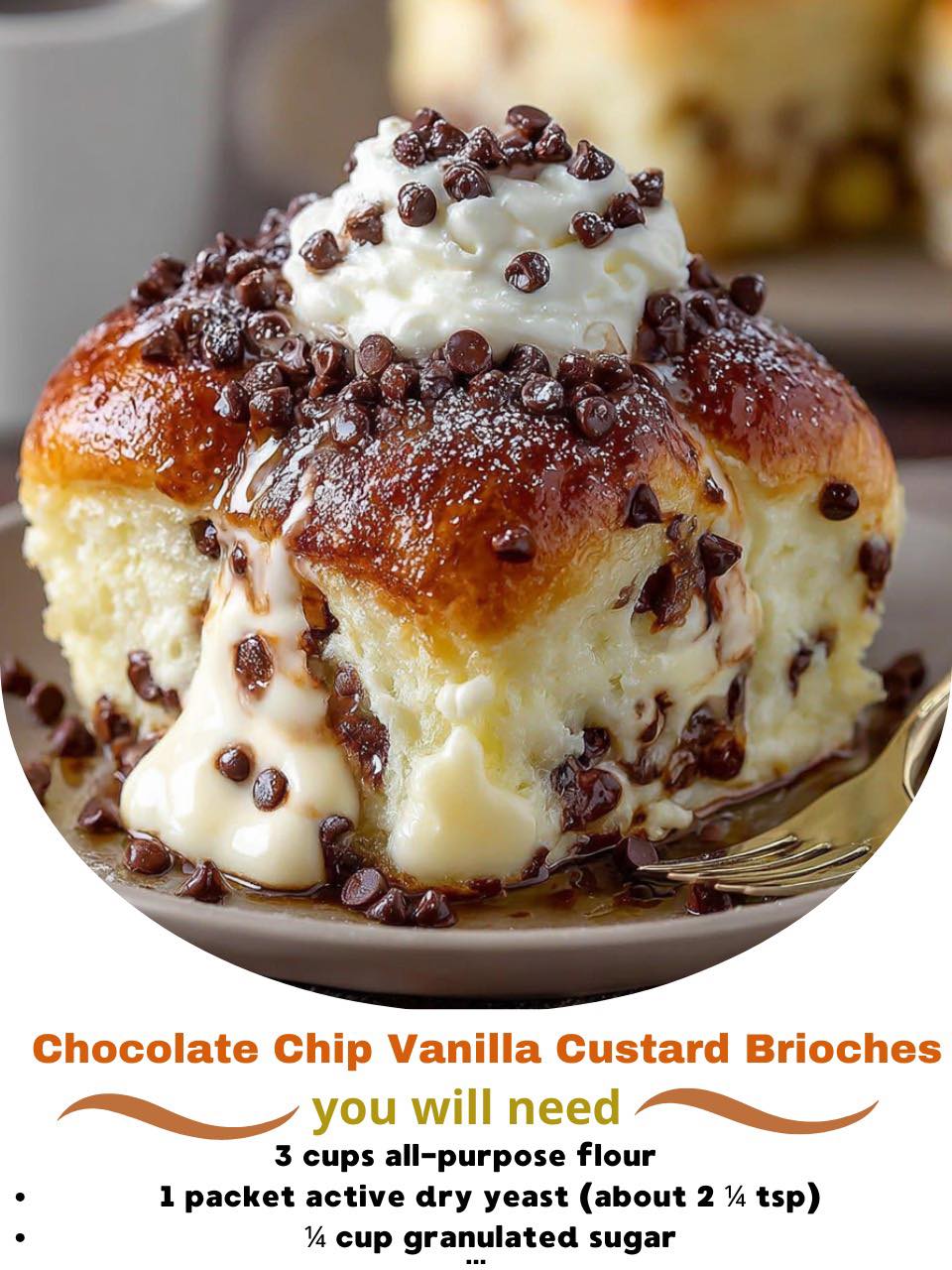
Chocolate Chip Vanilla Custard Brioches start with enriched brioche dough—loaded with eggs and butter—left to rise slowly until it’s pillowy and fragrant. A smooth vanilla custard (crème pâtissière) is prepared separately, infused with real vanilla and cooked until thick and glossy.
The dough is then rolled into a rectangle, spread with a generous layer of custard, sprinkled with mini chocolate chips, and folded before being cut into individual pieces and left to rise again. After baking, the brioches are brushed with syrup for shine and extra softness, resulting in a pastry that’s tender, creamy, and studded with melted chocolate in every bite.
Equipment
- Stand mixer with dough hook (or strong mixer for brioche dough).
- Mixing bowls (medium and large).
- Saucepan and whisk for the custard.
- Rolling pin.
- Sharp knife or bench scraper for cutting dough.
- Baking sheet lined with parchment paper.
Ingredients
Brioche dough
Quantities below are typical for about 8–10 Swiss‑style brioches.
- 2½–3½ cups all‑purpose flour (about 250–440 g), depending on recipe yield.
- ¼–⅓ cup granulated sugar (about 30–70 g).
- 1 teaspoon fine salt.
- 2¼ teaspoons instant or active dry yeast, or about 10 g fresh yeast.
- 3–4 large eggs, lightly beaten (about 150–200 g).
- ½–⅔ cup unsalted butter, softened and diced (about 115–165 g).
- ¼–½ cup warm milk (if using milk‑based brioche variant).
Vanilla custard (crème pâtissière)
- 1–1¼ cups whole milk (about 250 ml).
- 1 teaspoon butter.
- 1 vanilla pod (bean), split and seeds scraped, or 1–2 teaspoons vanilla extract.
- 2 egg yolks.
- ¼ cup sugar (about 50 g).
- 3 tablespoons cornstarch (about 20 g).
- 1 tablespoon all‑purpose flour (adds extra body).
Filling, egg wash, and syrup
- ¾–1 cup mini chocolate chips (about 120 g).
- 1 egg + 1 egg yolk, beaten, for egg wash.
- ¼ cup sugar + ¼ cup water for simple syrup.
Instructions And Steps
1. Make the brioche dough
In the bowl of a stand mixer fitted with the dough hook, combine flour, sugar, salt, and yeast, taking care to keep the salt and yeast on opposite sides at first so the salt doesn’t touch the yeast directly. Briefly mix to combine dry ingredients.
Add the beaten eggs (and warm milk, if your recipe uses it), then mix on medium speed until a rough, thick dough forms, about 2–3 minutes. The dough will look shaggy at this point but should start to pull together around the hook.
With the mixer running on medium, gradually add the softened butter a few pieces at a time, letting each addition fully incorporate before adding more. Continue kneading for 10–20 minutes, scraping the bowl as necessary, until the dough becomes smooth, elastic, and slightly sticky but no longer clings heavily to the sides of the bowl. Well‑kneaded brioche dough should pass a “windowpane” test—stretching thinly without tearing easily.
Scrape the dough into a lightly greased bowl, cover tightly with plastic wrap, and let it rise at warm room temperature until roughly doubled in size (about 1½–2 hours, depending on temperature). For flavor and easier shaping, gently deflate the dough, pat it into a thick rectangle, wrap or cover, and refrigerate for at least 1–5 hours or overnight.
2. Prepare the vanilla custard
While the dough chills, make the custard. In a small saucepan, heat the milk and butter over medium heat with the split vanilla pod and scraped seeds (or vanilla extract added later). Bring just to a simmer.
In a separate bowl, whisk the egg yolks with sugar until slightly pale. Add the cornstarch and flour, whisking until fully smooth and lump‑free.
Remove the vanilla pod from the hot milk. Slowly pour the hot milk into the yolk mixture in a few additions, whisking constantly to temper the eggs and avoid scrambling. Once combined, pour the mixture back into the saucepan and cook over low‑medium heat, whisking continuously until the custard thickens and bubbles slightly. It should become smooth and hold soft ribbons.
Transfer the custard to a clean bowl, press plastic wrap directly on the surface to prevent a skin, and refrigerate until completely chilled and set. This can be done ahead; chilled custard is easier to spread.
3. Roll and fill the dough
On a lightly floured surface or parchment paper, roll the chilled brioche dough into a large rectangle, about 8×12 inches (20×30 cm) or slightly larger, depending on recipe and desired brioche size.
Stir or whisk the chilled custard to loosen it into a spreadable consistency. Spread the custard evenly over one long half of the dough rectangle, leaving a small border around the edges to prevent leakage. Sprinkle the mini chocolate chips evenly over the custard.
Gently press the chocolate chips into the custard with a rolling pin or your hands so they adhere and don’t roll off when you fold the dough. Fold the uncovered half of the dough over the custard‑covered side like closing a book, aligning the edges. Press along the edges and across the surface to remove any trapped air bubbles, then lightly roll the top to smooth and slightly elongate the folded rectangle.
4. Cut and proof the brioches
Using a sharp knife or bench scraper, cut the filled dough into equal rectangles, about 8–10 pieces, roughly 1–1½ inches (3–4 cm) wide. Place the pieces, cut side down, on a parchment‑lined baking sheet, spacing them apart to allow room for rising.
Cover loosely with plastic wrap or a clean towel and let them proof at warm room temperature for about 1–2 hours, or until noticeably puffy and nearly doubled. Because the dough is enriched and chilled, this second rise can be relatively long; patience here gives the best texture.
5. Prepare syrup and egg wash
While the brioches proof, make the simple syrup by bringing equal parts sugar and water (for example, ¼ cup each) to a boil in a small saucepan until the sugar dissolves. Set aside to cool.
Beat one egg with one egg yolk (or use a single egg) for egg wash. Preheat the oven to 350°F (180°C) near the end of the proofing time.
6. Bake and glaze
Brush the tops of the proved brioches gently with the egg wash, taking care not to deflate them. Bake in the preheated oven for about 10–15 minutes (timing varies by size) until they are deep golden on top and lightly colored on the sides.
As soon as they come out of the oven, brush the hot brioches with the cooled simple syrup to give them a glossy finish and extra moisture. Transfer to a wire rack to cool completely before serving; the custard will set further as they cool, making them easier to handle.
Tips And Tricks
Use strong, well‑developed brioche dough. Proper gluten development and slow addition of butter are key for light, fluffy brioches that can hold the custard without collapsing. The dough should be soft but elastic, not dry; a slightly sticky dough is normal for brioche.
Chill the dough before shaping. Cold brioche dough is much easier to roll and handle—enriched doughs can be very soft at room temperature. An overnight rest in the fridge also improves flavor.
Use real vanilla if possible. Vanilla bean or high‑quality extract gives depth to the custard that stands out against the buttery brioche and chocolate. Scraping a vanilla pod directly into the milk, as some recipes suggest, gives a very aromatic pastry cream.
Cook custard low and slow. Constant whisking over gentle heat prevents curdling and lumps. If lumps appear, you can quickly strain the hot custard through a fine sieve before chilling.
Mini chocolate chips work best. They distribute more evenly, stay suspended in the custard, and make slicing and folding easier than large chocolate chunks.
Don’t skip the final proof. Even though the dough has risen once, a generous second rise after shaping lets the brioches puff properly and gives a soft, airy crumb.
Brush with syrup immediately. Applying syrup while the brioches are hot allows it to soak slightly into the crust, producing shine and a tender, bakery‑style finish.
Variations
Rolled buns vs. Swiss rectangles:
The “brioches suisses” format is typically flat rectangles folded around a central strip of custard and chocolate, but some bakers roll the filled dough like a Swiss roll and cut into spiral buns. Both formats use the same dough and filling; only the shaping changes.
Different chocolates:
Swap mini milk chocolate chips for dark or semi‑sweet, or use chopped chocolate bars for pools of melted chocolate instead of small chips. Some recipes also sprinkle a few chips on top before baking for a more chocolate‑forward look.
Extra‑rich custard:
Use part milk and part cream in the pastry cream for an even richer filling, as some pastry recipes do. A touch of butter whisked in at the end adds shine and smoothness.
Flavored variations:
Add a spoonful of orange zest or a splash of orange blossom water to the custard for a citrus twist, or sprinkle finely chopped nuts with the chocolate for added crunch. A bit of rum or liqueur (added after cooking the pastry cream) can give an adult dessert edge.
Pan arrangement:
Instead of baking as separate pieces on a tray, you can arrange the cut brioches in a round or square tin, letting them rise and bake as pull‑apart buns. This yields soft sides and a more communal presentation.
Chocolate Chip Vanilla Custard Brioches are a bakery‑caliber treat that reward a bit of patient dough work with tender crumb, silky vanilla filling, and pockets of melted chocolate—perfect for brunch, special breakfasts, or any time a “delightful” pastry is in order.