
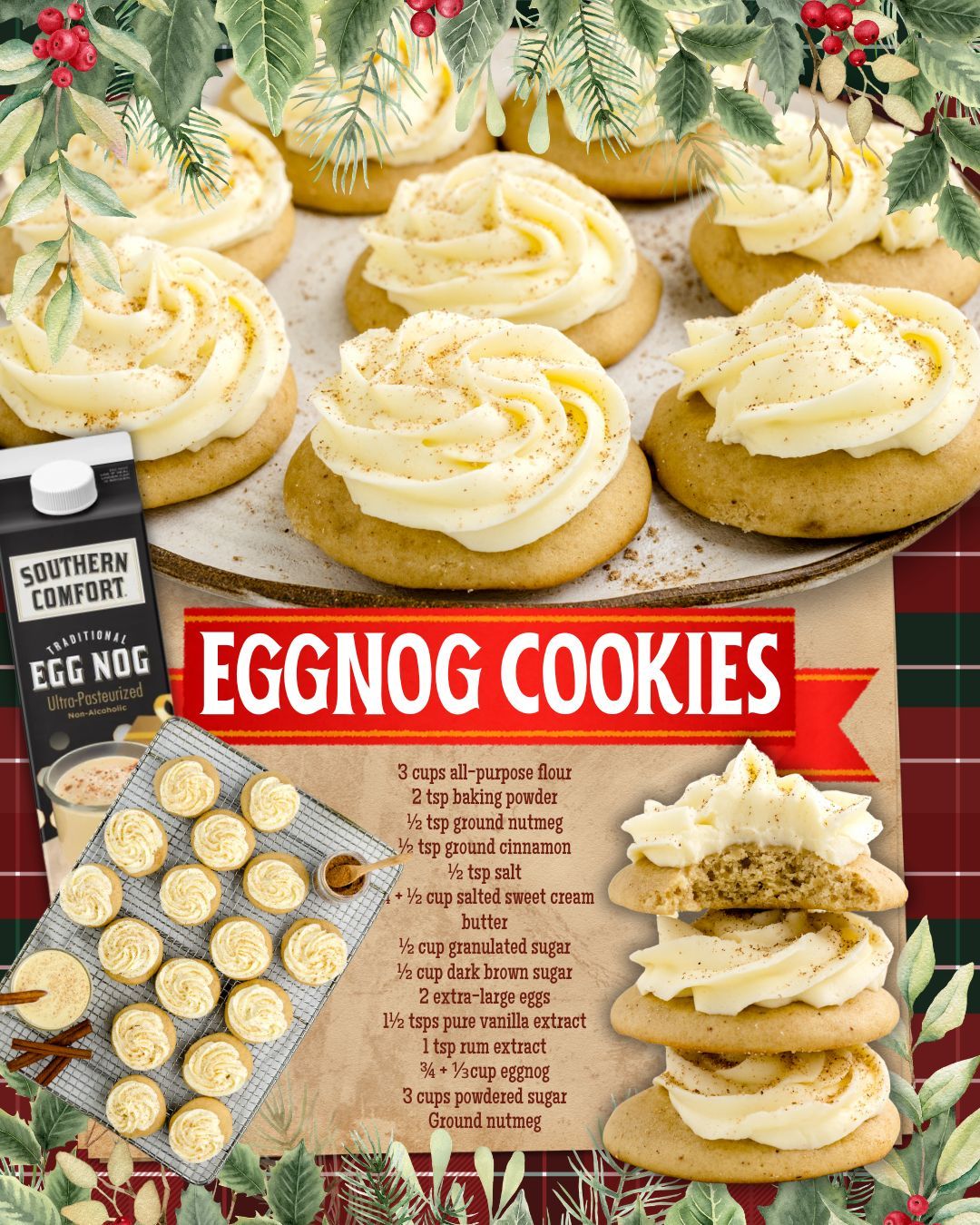
Most eggnog cookie recipes are built on a classic creamed‑butter cookie base that swaps some of the usual milk or cream for eggnog and increases nutmeg and cinnamon to highlight that holiday flavor. The butter and sugar are creamed until light and fluffy, egg and vanilla are beaten in, then a splash of eggnog goes into the wet mixture before folding in flour, leavening, salt, and spices to form a soft dough.
The cookies can be scooped and baked as soft drop cookies or shaped and sliced, then topped with a simple eggnog glaze or frosting made from powdered sugar and eggnog to reinforce the flavor. The result is a tender, melt‑in‑your‑mouth cookie with delicate crispy edges, a fluffy center, and a sweet, creamy finish that tastes like Christmas in cookie form.
Equipment
- Large mixing bowl for creaming butter and sugars and mixing the dough.
- Medium bowl for whisking together flour, baking powder/soda, salt, and spices.
- Hand mixer or stand mixer with paddle attachment to cream butter and sugar and beat in egg and eggnog.
- Measuring cups and spoons for flour, eggnog, sugar, and spices.
- Rubber spatula for scraping the bowl and folding the dough together.
- Cookie scoop or tablespoon for portioning dough (usually 1–2 tablespoons per cookie).
- Baking sheets lined with parchment paper or silicone baking mats to prevent sticking and encourage even browning.
- Wire cooling racks to cool cookies fully before glazing or frosting.
- Small bowl and whisk for making eggnog glaze or icing.
Ingredients (with measurements)
Exact recipes vary, but a typical soft, glazed eggnog cookie batch looks like this.
For the cookies:
- 2½–3⅓ cups (325–375 g) all‑purpose or cake flour (many recipes use around 2½ cups AP flour; some use 3⅓ cups cake flour for extra tenderness).
- 1 teaspoon baking powder and/or ¼–½ teaspoon baking soda, depending on recipe.
- ½–1 teaspoon ground cinnamon.
- ¼–1 teaspoon ground nutmeg (egg nog’s signature spice; some recipes use up to 1 teaspoon or add more on top).
- ½–¾ teaspoon salt (table or kosher).
- ¾–1 cup (170–226 g) unsalted butter, softened to room temperature.
- 1–1½ cups (200–300 g) granulated sugar; some recipes add ¼–⅓ cup (50–70 g) light brown sugar for extra chew and flavor.
- 1 large egg or 2 egg yolks, room temperature, depending on recipe.
- 1–2 teaspoons vanilla extract.
- ¼–1 cup (60–240 ml) eggnog; small amounts like ¼ cup enrich a sugar‑cookie‑style dough, while some recipes use up to 1 cup eggnog with extra flour and yolks for very eggnog‑forward cookies.
- Optional ½ teaspoon rum extract for that classic “eggnog with rum” flavor.
For the glaze or icing:
- 1–1½ cups (115–180 g) powdered sugar.
- 2–4 tablespoons (30–60 ml) eggnog, enough to reach drizzle or spreadable consistency.
- Optional ½ teaspoon vanilla or rum extract.
- Pinch of nutmeg or cinnamon to whisk into the glaze or sprinkle over the top.
This combination typically yields about 24–36 medium cookies, depending on scoop size.
Instructions and steps
The dough starts with combining the dry ingredients. In a medium bowl, flour, baking powder, baking soda (if used), salt, cinnamon, and nutmeg are whisked together until everything is evenly mixed and there are no clumps of spice or leavening. This ensures that the spices are dispersed throughout and the cookies rise uniformly.
In a separate large bowl, the softened butter and sugar(s) are creamed together. Using a hand mixer or stand mixer on medium speed, butter and granulated sugar (plus brown sugar if included) are beaten for 2–3 minutes until the mixture becomes lighter in color and fluffy.
Creaming properly is important for tender cookies because it incorporates air and helps dissolve the sugar. After creaming, the egg or egg yolks and vanilla (and rum extract if using) are added and beaten into the butter‑sugar mixture until fully combined and smooth.
Eggnog is then mixed into the wet ingredients. Most recipes pour in ¼ to ½ cup of eggnog and beat or stir until the mixture is uniform; some that call for a full cup of eggnog also use extra yolks and flour to maintain structure. At first, the batter may look slightly curdled because eggnog adds extra liquid, but it smooths out as the flour goes in.
The dry ingredients are added next. With the mixer on low speed, the flour‑spice mixture is added gradually to the wet mixture, mixing only until just combined and no streaks of flour remain.
Overmixing at this stage can make the cookies tough, so most recipes emphasize stopping as soon as the dough comes together. The dough should be soft and slightly sticky but scoopable; some versions are more batter‑like and dropped by spoonfuls, while others are firmer and can be rolled into balls.
In many soft‑drop cookie recipes, there’s no need to chill the dough; it can be portioned right away. Cookies are scooped onto parchment‑lined baking sheets using a cookie scoop or tablespoon, leaving a couple of inches between them for spreading.
For slice‑and‑bake styles, the dough is shaped into a log, chilled until firm, then sliced into rounds before baking. A few recipes recommend chilling for 30–60 minutes to help the cookies hold a slightly thicker shape and deepen flavor, especially when the dough is loose from a higher eggnog amount.
The cookies bake at around 325–350°F (165–180°C), depending on the recipe, for 8–15 minutes. Smaller cookies at higher temperatures (around 350°F) usually take 8–12 minutes, while larger, low‑temp bakes (around 300–325°F) may run up to 20 minutes. Visual cues: the edges should look set and just barely golden, and the tops may appear dry with tiny cracks but still pale—overbaking will sacrifice that soft, tender texture.
After baking, the cookies rest on the baking sheet for a few minutes to firm up before being transferred to a wire rack to cool completely. It’s important that the cookies are fully cool before glazing so the icing doesn’t soak in or slide off completely.
To make the eggnog glaze or icing, powdered sugar is combined with eggnog in a small bowl, often with a bit of vanilla or rum extract and a pinch of nutmeg or cinnamon, and whisked until smooth. The amount of eggnog is adjusted a teaspoon at a time to reach the desired consistency: slightly thicker for spreading, thinner for drizzling.
Once the cookies are cool, the glaze is spooned or drizzled over the tops, or the cookie tops are dipped face‑down into the glaze and allowed to drip off excess. Many bakers finish by sprinkling a little extra nutmeg over the wet glaze for a classic eggnog look and extra spice.
The glazed cookies are left out until the icing sets, which can take 20–60 minutes depending on thickness, then they can be stored in an airtight container. They stay soft for several days and are often described as even better the next day as the eggnog flavor continues to develop.
Variations
Eggnog cookies are easy to adapt with small changes in spices, mix‑ins, and toppings. Some recipes lean heavily into nutmeg as the primary spice, using freshly grated nutmeg and less cinnamon for a flavor closer to straight eggnog. Others add rum extract or a bit of real rum to the dough or glaze (in small amounts) to mimic boozy eggnog, though most remain family‑friendly by using only extracts.
Frosting styles vary too. Instead of a thin glaze, some bakers top cooled cookies with a thick, buttery eggnog frosting—essentially a buttercream made with butter, powdered sugar, and eggnog, whipped until fluffy and piped or spread generously on top.
This creates a richer, more dessert‑like cookie that feels almost like a mini eggnog cake bite. On the lighter side, a simple drizzle of eggnog icing plus a dusting of nutmeg keeps the cookies less sweet overall.
Structurally, there are slice‑and‑bake eggnog cookies that chill into logs and are sliced into rounds, then baked and topped with eggnog glaze, offering neatly uniform cookies great for gifting.
Other versions keep the dough softer and drop‑style, focusing on ultra‑chewy, pillow‑y centers, sometimes using cake flour or extra eggnog for a more tender crumb. A few recipes even incorporate chai or other warm spices in the cookie and use eggnog only in the glaze for a chai‑eggnog combination.
No matter the spin, the core concept stays the same: start with a soft, buttery cookie base, mix in eggnog and holiday spices, bake until just set, and finish with an eggnog‑based glaze or frosting. The result is a festive cookie that captures the nostalgic flavor of eggnog in a handheld, sharable treat.